
Greenhouse gas storage authorities
An appropriate resource authority is required before you can conduct any exploration or injection activity for greenhouse gas (carbon dioxide) storage areas in Queensland.
In Queensland, greenhouse gas (GHG) storage is regulated under the following Acts:
- Greenhouse Gas Storage Act 2009 (GGS Act)
- Petroleum and Gas (Production and Safety) Act 2004
- Mineral and Energy Resources (Common Provisions) Act 2014
- Water Act 2000
- Environmental Protection Act 1994.
The main purpose of the GGS Act is to help reduce the impact of GHG emissions on the environment by facilitating GHG storage, and to regulate the exploration and use of underground geological formations or structures to store carbon dioxide (CO2).
This guide describes the process of carbon capture and storage and carbon sequestration, as well as the types of resource authorities that are granted and administered under the GGS Act, their main features, and how to apply.
Greenhouse gas storage in Great Artesian Basin
In June 2024, the Queensland Government introduced a legislative ban on GHG storage activities in the Great Artesian Basin (GAB), in Queensland.
For the purpose of the ban, the GAB is defined under the GGS Act as the area that is on or below the surface of the plan area under the Water Plan (Great Artesian Basin and Other Regional Aquifers) 2017 (PDF, 1.2MB).
The ban extends to all existing and any future proposals for GHG storage projects in the GAB in Queensland.
The area of a GHG permit or lease must not include land within the area of the GAB in Queensland.
GHG storage activities may be able to occur in other areas of Queensland outside of the GAB, subject to existing regulatory assessment and approval processes.
Read more about the ban on GHG activities in the GAB.
About greenhouse gas storage
In Queensland, greenhouse gas (GHG) storage refers to the geological storage of captured carbon dioxide (CO2). CO2 is typically produced from the use of fossil fuels in electricity generation and industrial processes. CO2 may also be captured from bio-based processes, and directly from the atmosphere via direct air capture. The process of capturing CO2 and placing it in geological storage is also referred to as carbon capture and storage (CCS).
A company that wants to explore for GHG storage sites and eventually inject CO2 must first apply for a greenhouse gas exploration permit and an environmental authority. Any native title requirements will also need to be addressed before an exploration permit is granted.
In Queensland, GHG storage activities are prohibited within the area of the Great Artesian Basin, that is the area on or below the surface of the plan area under the Water Plan (Great Artesian Basin and Other Regional Aquifers) 2017 (PDF, 1.2MB).
The Queensland Government manages competitive tendering for greenhouse gas storage exploration. Find out about current tender opportunities.
Carbon capture and storage process
Although each carbon capture and storage project is unique, CCS projects typically include the following steps:
- A source of CO2 is identified, such as an industrial facility or power station.
- CO2 is captured from its source and separated from other gases or contaminants.
- CO2 is cooled and compressed into a liquid in advance of transporting.
- Compressed CO2 is transported to the storage site via pipeline or truck.
- CO2 is injected through a well into deep underground geological formations at depths of 800 metres or more. It is permanently trapped by:
- geological storage—using surrounding solid rock to stop the gas from moving out of the formation
- using water in the formation to absorb the CO2
- mineralisation—using coal or other compounds in the rock to bind the CO2.
- The migration pathways of greenhouse gas streams are monitored before, during and after injection into the relevant GHG storage reservoir.
Underground reservoirs and aquifers
GHG storage exploration is similar to petroleum and gas exploration because both involve exploration for a suitable geological reservoir.
Crude oil and natural gas, including CO2-rich waters, are stored naturally underground, where they are trapped in deep reservoirs. These reservoirs are porous geological formations that are capped by an impermeable layer of rock, which acts as a seal.
Figure 1: Vertical cross-section of ground layers showing where gas, petroleum, coal and groundwater can be found. Insets compare reservoir and seal composition.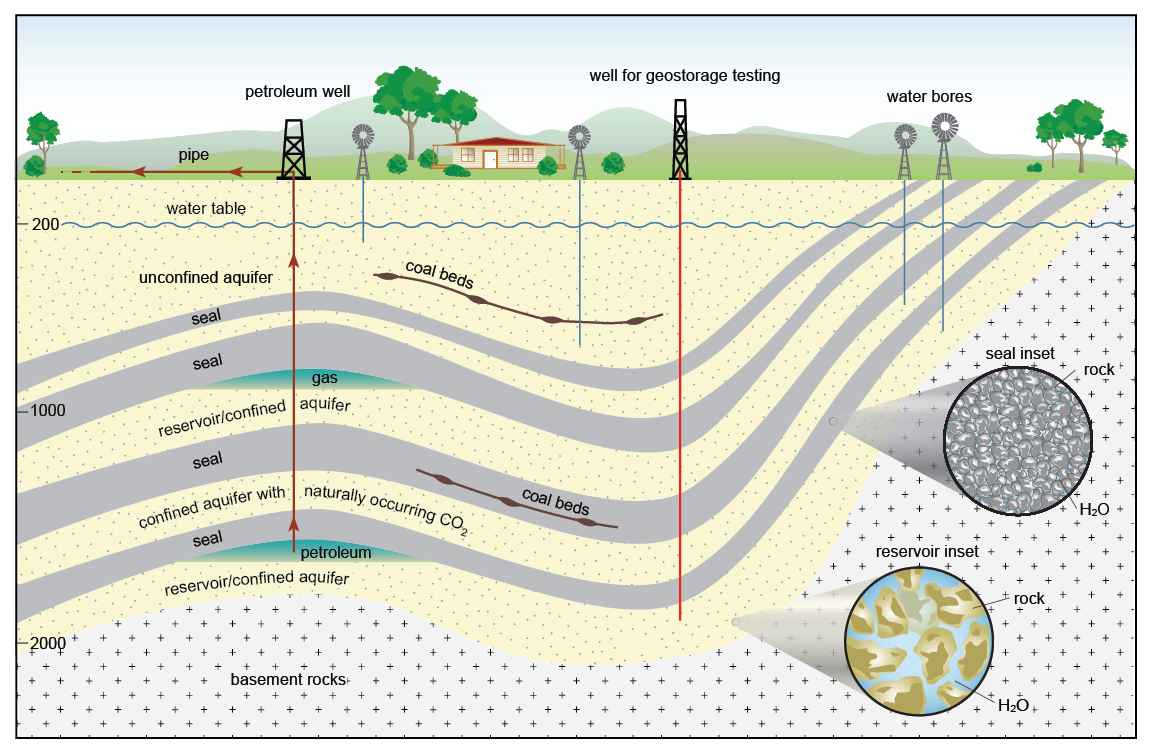
Sediments accumulate to form successive layers of rock with varying permeabilities that overlay an impermeable hard-rock geological basement.
Highly porous and permeable layers can store hydrocarbons and/or water and are referred to as reservoirs or aquifers, respectively. Layers of lower permeability (usually with smaller grain and pore sizes) seal the reservoirs and aquifers, preventing the loss of hydrocarbons and/or mixing of groundwaters.
Sedimentary basins hold resources that are often targeted for a variety of activities (i.e. extraction of hydrocarbons, coal and water), all taking place within a small area but at different depths. Water extraction, for instance, can occur at very shallow depths from unconfined (unsealed) aquifers or from greater depths from confined (sealed) aquifers.
What happens if a suitable reservoir is found
If a potentially suitable reservoir for CO2 storage is found during the exploration phase, the exploration permit holders will need to apply for a greenhouse gas injection and storage lease and secure the required environmental approvals before any pilot or commercial scale storage of CO2 is undertaken.
Also consider...
- Read our guide to the application process for resource authorities for general information about lodging an application.
- Find out how to comply with your resource authority and the land access code.
About carbon sequestration
The term carbon sequestration is used to differentiate from greenhouse gas storage under the Greenhouse Gas Storage Act 2009 (GGS Act).
Carbon sequestration describes the process of removing or capturing carbon dioxide (CO2) from the atmosphere and preventing from returning to the atmosphere through biological, geological or technological storage means.
Projects using emerging technologies that require chemical reactions in the production process to create carbon sequestration will be considered on a case-by-case basis.
The GGS Act does not provide for emerging technologies regarding carbon capture and utilisation. A summary of how the regulatory framework is applied is provided below.
Gas injected for oil extraction
This method involves CO2 being injected into a reservoir as part of the recovery of secondary gas or petroleum, and the injected CO2 may remain in a petroleum reservoir once production ceases.
Injecting a greenhouse gas stream for the purpose of enhanced petroleum recovery is authorised under the Petroleum Act 1923 Act or the Petroleum and Gas (Production and Safety) Act 2004. It is not greenhouse gas storage under the GGS Act.
Using a GHG stream for enhanced petroleum recovery is not permitted within the area of the Great Artesian Basin in Queensland—defined as the area that is on or below the area the surface of the plan area under the Water Plan (Great Artesian Basin and Other Regional Aquifers) 2017 (PDF, 1.2MB).
In-situ carbon sequestration
Mineral carbonation is a process whereby substances (including CO2) are injected into certain rocks that result in the CO2 being converted into mineral. These minerals may then be left in-situ or may be mined. Authority to undertake activities to identify rock formations can be conducted under either the Mineral Resources Act 1989 (MR Act) or GGS Act.
Progressing to a higher tenure will depend on the outcome of the exploration phase. Projects will be considered on a case-by-case basis to address the specific circumstances of the proposed project.
Injecting GHG into rock formations for in-situ mineral carbonation is regulated under the GGS Act and is not permitted within the area of the Great Artesian Basin.
Non-in-situ carbon sequestration
A mining lease granted under the MR Act is required when a project involves mining minerals that are subjected to carbon sequestration processes after extraction. For clarity, in this scenario the carbon sequestration occurs as part of an industrial process post-mining.
Salt caverns
Salt caverns formed out of existing salt bed deposits have been identified as having potential for CO2 storage. An exploration permit under the MR Act may be granted for the purposes of exploring for potential salt mineralisation if the intent is to extract salt in the future.
However, any cavity subsequently formed from salt mining would require a greenhouse gas storage authority under the GGS Act to explore the suitability of the geological storage formations or to conduct activities necessary to confirm the integrity of the formation. GHG storage in salt caverns is not permitted within area of the Great Artesian Basin.
Overlapping resource authorities
Where it is not possible to transition between different types of resource authorities, the overlapping provisions of the resource Acts allow for multiple resource authority types over the same area at the same time.
If a resource proponent is considering the viability of CO2 storage in areas outside of the GAB, an expression of interest may be made to the GGS Act Minister to consider the release of land. Proponents should be aware that expressing an interest in land does not guarantee that the proponent will be granted a tenure following the completion of the tender process.
Also consider...
- Read our guide to the application process for resource authorities for general information about lodging an application.
- Find out how to comply with your resource authority and the land access code.
- Find out more about greenhouse gases.
- Learn about current global carbon capture and storage projects.
Exploration permit for greenhouse gas
To search for greenhouse gas (GHG) storage locations in Queensland you need an exploration permit for greenhouse gas (EPQ).
An EPQ cannot be granted within the area of the Great Artesian Basin in Queensland, defined as the area that is on or below the surface of the plan area under the Water Plan (Great Artesian Basin and Other Regional Aquifers) 2017 (PDF, 1.2MB).
Permitted activities
An EPQ allows you to explore for GHG storage reservoirs within the permit area. It also allows you to carry out injection testing (with ministerial approval) and activities necessary for exploration. Your activities must follow your approved work program.
Environmental authorities
Before we grant a resource authority you will require the appropriate environmental authority.
Native title
Any native title requirements will need to be addressed before we grant an authority.
Main features of EPQs
| Feature | Details |
|---|---|
| Prerequisite authority | NA |
| Duration | Maximum of 5 years |
| Size | 100 blocks |
| Area | Must not be within the Great Artesian Basin in Queensland |
| Renewable | Yes |
| Rent | {{ pass_35444 }} per sub-block |
| Application fee | {{ pass_35424 }} |
How to apply
You can apply through a call for tenders.
Also consider...
- Read our guide to the application process for resource authorities for general information about lodging an application.
- Find out how to comply with your resource authority and the land access code.
Potential greenhouse gas storage commercial area
If you discover a potential storage area, you can apply to have an area of your exploration permit declared as a potential greenhouse gas (GHG) storage commercial area (PSA). This will allow you to evaluate the area's potential and market opportunities.
When an area is declared as a PSA, it remains part of the exploration permit. When the PSA expires, the declared area ceases to be part of the original permit.
Main features of PSAs
| Feature | Details |
|---|---|
| Prerequisite authority | GHG exploration permit |
| Duration | Maximum of 10 years |
| Size | No restrictions |
| Area | Must be within the area of an existing GHG exploration permit located outside of the Great Artesian Basin in Queensland. |
| Renewable | No |
| Application fee | {{ pass_35428 }} |
How to apply
Complete an application form and lodge it through MyMinesOnline or a mines lodgement office.
Also consider...
- Read our guide to the application process for resource authorities for general information about lodging an application.
- Find out how to comply with your resource authority and the land access code.
Greenhouse gas injection and storage lease
Greenhouse gas (GHG) injection and storage leases (QLs) are long-term authorities to allow you to commercially develop a storage site.
A QL cannot be granted within the area of the Great Artesian Basin in Queensland, that is the area on or below the surface of the plan area under the Water Plan (Great Artesian Basin and Other Regional Aquifers) 2017 (PDF, 1.2MB).
Permitted activities
A QL allows you to:
- explore for GHG storage areas
- evaluate the feasibility of GHG stream storage, including GHG storage injection testing
- compress or otherwise process a GHG stream for GHG stream storage
- store a GHG stream
- monitor and verify the behaviour of the GHG streams.
Environmental authorities
Before we grant a resource authority you will require the appropriate environmental authority.
Native title
Any native title requirements will need to be addressed before we grant an authority.
Main features of QLs
| Feature | Details |
|---|---|
| Prerequisite authority | Exploration permit for greenhouse gas (not required for tenders) |
| Duration | No maximum |
| Size | No restrictions |
| Area | Must not be within in the Great Artesian Basin in Queensland |
| Renewable | Yes |
| Rent | {{ pass_35445 }} per km2 |
| Application fee | Direct application: {{ pass_35429 }} |
How to apply
Complete an application form and lodge it through MyMinesOnline or a mines lodgement office. You can also apply through a call for tenders.
Also consider...
- Read our guide to the application process for resource authorities for general information about lodging an application.
- Find out how to comply with your resource authority and the land access code.
Data acquisition authority
A data acquisition authority (DAA) authorises you to conduct limited geophysical survey activities and collect data outside the area of your exploration permit or lease. A DAA is only granted on land that is contiguous to the granted exploration permit or lease and for activities that are directly relevant to authorised activities of your exploration permit or lease.
A DAA can be granted for a maximum term of 2 years and ends if the exploration permit or lease with which it is associated ends.
How to apply
Complete an application form and lodge it through MyMinesOnline or a mines lodgement office.
Fees
- Application fee: {{ pass_35434 }}.
- Annual rent: {{ pass_35446 }} per sub-block.
Also consider...
- Read our guide to the application process for resource authorities for general information about lodging an application.
- Find out how to comply with your resource authority and the land access code.
© The State of Queensland 1995–2026