
Humane killing of injured livestock
There are situations when it is appropriate to humanely kill livestock to prevent suffering. Livestock that have been hit by a vehicle or seriously injured, including in a natural disaster, are examples where humane killing may be necessary.
A person must only kill an animal in a way that is consistent with the requirements of the Animal Care and Protection Act 2001. The killing must:
- be humane
- cause the animal to die quickly and without unreasonable pain.
The most efficient and common way to humanely kill livestock is by a close range gunshot to the brain. Using a firearm can be dangerous, so the following points must be considered:
- Only properly trained and licensed people should use firearms.
- There may be legal restrictions on discharging a firearm in certain areas and police permission may be necessary.
- A small calibre firearm is most suitable to reduce the risk of projectiles exiting the head. A .22 or .22 magnum calibre rifle is adequate for most animals if the shot is correctly positioned.
- The range should be as short as possible, but the barrel should never touch the animal's head.
- People should be well clear of the area or stay behind the person shooting.
- The animal must be still and properly restrained. Never fire while the animal is moving its head. Shooting at a moving animal is extremely hazardous to bystanders and may result in further suffering.
Different methods are recommended for different types of animals.
After applying an accepted method of humane killing appropriate for the species, you must confirm the animal is dead by observing the following signs:
- No jaw tone
- No tongue tone
- No corneal reflex (no blinking when touching the surface of the eyeball)
- Fixed dilate pupils
- No rhythmic breathing
This guide contains information on the recommended methods for humanely killing livestock.
Humane killing of horses and goats
Horses
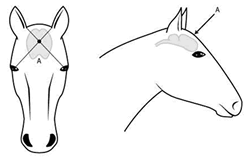
The recommended ways to kill a horse are by firearm or lethal injection. If you choose to use a firearm, the preferred method is by a rifle shot using the frontal method. The ideal site is slightly above (1cm) the intersection of 2 imaginary lines drawn from the eye to the opposite ear.
For adult horses, a rifle should deliver at least the muzzle energy of a standard 0.22 magnum cartridge. For foals, a rifle should deliver at least the muzzle energy of a standard 0.22 long rifle cartridge.
Goats
To humanely kill a goat of any age either:
- use a firearm
- stun with a captive bolt then immediately bleed out; or
- give a lethal injection.
For kids under 24 hours old, blunt trauma may also be used, provided this can be done competently and the other options are not available.
If you choose to use a firearm or captive bolt, the poll method is the preferred method. A firearm should deliver at least the muzzle energy of a standard 0.22 long rifle cartridge. To position the captive bolt or gun, select a site in the middle just behind the bony ridge between the horns, and aim towards the back of the throat (as for horned sheep).
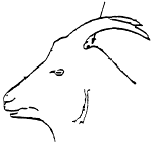
After shooting the brain with a captive bolt, the animal should be bled out immediately to ensure death.
Bleeding out only
Goats should be stunned by captive bolt before bleeding out; however, bleeding out alone can be used in an emergency.
If you are bleeding out the animal:
- Make sure you use a sharp knife at least 6 inches long.
- Make sure to cut both carotid arteries
- Do not under any circumstances break or sever the spinal cord. This just causes more pain and also paralysis, which adds to the potential for stress.
Blunt trauma
Blunt trauma should only be used when there is no other recommended option for humane killing. It can only be used on kids that are less than 24 hours old.
The use of blunt trauma on newborn young goats of less than 24 hours old must immediately be followed by bleeding-out, while the animal is unconscious, to ensure death.
Also consider
- Read about duty of care for animals.
- Read about animal welfare codes of practice.
Humane killing of cattle
A firearm or a captive-bolt are both suitable methods for humanely killing adult cattle. The firearm should deliver at least the muzzle energy of a standard 0.22 magnum cartridge. For larger animals and bulls, 0.30 calibre high-power cartridges are recommended.
For calves a rifle should deliver at least the muzzle energy of a standard 0.22 long rifle cartridge.
Use of a captive bolt must deliver the correct charge and be followed by bleeding out to ensure death.
Frontal method - suitable for firearm or captive bolt
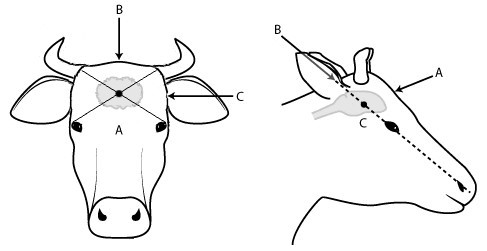
Aim the firearm at the point of intersection of lines taken diagonally from the top of each ear to the inside corner of the opposite eye (position A).
Poll method
The poll method is not recommended for cattle. Only use the poll method if accessing the frontal position is not possible.
The animal is shot from above (position B) mid-way between each ear with the direction of aim down towards the muzzle of the animal.
Temporal method - suitable for firearm only
The animal is shot from the side so that the bullet enters the skull midway between the eye and the base of the ear on the same side of the head (position C). The bullet should be directed horizontally.
The temporal position should only be used if frontal position is not possible.
Note: Stunning (by captive bolt) does not necessarily result in death. Bleeding out must be carried out immediately to ensure death occurs.
Blunt trauma
The use of blunt trauma on newborn young calves less than 24 hours old must immediately be followed by bleeding out, while the animal is unconscious, to ensure death.
Also consider
- Read about humane killing of unwanted calves.
- Read about duty of care for animals.
- Read about animal welfare codes of practice.
- Read about animal welfare law.
Humane killing of sheep
Sheep over 6 months old
To humanely kill a sheep over 6 months old:
- use a firearm
- stun with a captive bolt then immediately bleed out
- give a lethal injection
- bleed it out.
A firearm should deliver at least the muzzle energy of a standard 0.22 long rifle cartridge. After stunning with a captive bolt the animal must be bled out immediately to ensure death.
Position of rifle or captive bolt
For polled sheep, position the rifle or captive bolt in the midline on the highest point of the head, and aim straight down towards the angle of the jaw.

For horned sheep, position the rifle or captive bolt in the middle just behind the bony ridge between the horns, and aim towards the back of the throat. It is very important to bleed sheep immediately after using this position as they may otherwise regain consciousness.

Bleeding out only
Preferably sheep should be stunned by captive bolt before bleeding out; however, bleeding out alone can be used in an emergency.
To bleed out the animal:
- make sure you use a sharp knife at least 6 inches (15 cm) long
- make sure you cut both carotid arteries
- do not under any circumstances break or sever the spinal cord. This just causes more pain and also paralysis, which adds to the potential for stress.
Lambs
To humanely kill a lamb of any age:
- use a firearm
- stun with a captive bolt then immediately bleed out
- give a lethal injection
- bleed it out.
Blunt trauma should only be used when there is no other recommended option and must only be used on newborn lambs that are less than 24 hours old. Then immediately bleed out the lamb, while it is unconscious, to ensure death.
Also consider
- Read about duty of care to animals.
- Read about animal welfare codes of practice.
- Read about animal welfare law.
Humane killing of pigs
Adult pigs
The recommended methods are:
- firearm aimed in the frontal or temporal position
- captive bolt aimed in the frontal position
- lethal injection.
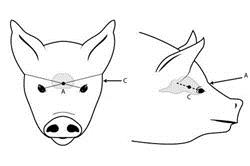
(A) indicates the frontal method for firearm and captive bolt, (C) indicates the temporal method suitable for firearm only. The dots indicate the point of aim and the arrows indicates the direction of aim.
A firearm should deliver at least the muzzle energy of a standard 0.22 magnum cartridge. For older boars and sows, use a 0.30 calibre firearm.
Most captive bolt pistols are suitable for small pigs; however, large pigs require the use of high-velocity captive bolt pistols. Animals should be bled out immediately after shooting with the captive bolt, while they are unconscious, to ensure death.
Piglets less than 15 kilograms
The recommended methods are:
- firearm
- stun with a captive bolt then immediately bleed out
- lethal injection.
A firearm should deliver at least the muzzle energy of a standard 0.22 long rifle cartridge and should be aimed in the frontal or temporal positions.
Blunt trauma should only be used when there is no other recommended option available. Only use blunt trauma on newborn piglets that are less than 24 hours old. Immediately bleed out the piglet, while it is unconscious, to ensure death.
Also consider
- Read about duty of care to animals.
- Read about animal welfare codes of practice.
- Read about animal welfare law.
Humane killing of unwanted calves
If you are a beef or dairy producer, you may be required to humanely kill calves. Calves with health problems, that have little or no commercial value or from farms in areas that do not have access to suitable markets, may be humanely killed.
You have an obligation to ensure that the killing method used is humane and performed as soon as possible after birth. Calves must be handled calmly and quietly, and not subjected to unnecessary distress, fear or pain.
There are 3 recommended methods of euthanizing calves:
- with a firearm
- with a captive-bolt pistol immediately followed by bleeding out
- lethal injection.
There is also an acceptable alternative method for premature and day-old calves.
Shooting
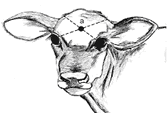
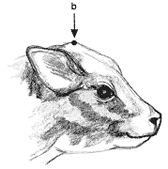
The most practical and humane way of killing calves is by immediately destroying the brain with a gunshot to the head.
- A .22 calibre rifle with soft nose projectiles is ideal for shooting calves.
- The preferred position is shown in positions 'a' and 'b' in the diagrams above.
- The range should be between 10cm and 25cm.
- The barrel should never be placed so it is touching the animal's head.
- Ensure the animal remains still as shooting at a moving animal is extremely hazardous to the animal and bystanders. Never fire while the animal is moving its head.
Only properly trained and licensed people should use firearms.
Captive-bolt pistol followed by bleeding out
A captive-bolt pistol fires a bolt into the skull to rapidly render the animal unconscious and allow it to be killed before regaining consciousness. Although captive-bolt pistols are not regarded as firearms, operators must be properly trained in their use.
When using a captive-bolt pistol ensure that:
- the instrument is pressed firmly against the skull before firing
- it is placed correctly to achieve a humane death
- the operator understands the animal may only be stunned and it is necessary to immediately bleed out the animal after firing
- blank cartridges are colour-coded according to the amount of charge they contain
- the manufacturer's recommendations are followed when selecting the cartridge to be used for calves
- it has been properly maintained as this is essential for it to operate correctly.
Bleeding out after rendering animal unconscious
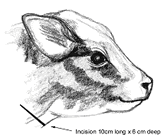
Bleeding out should only be done when the animal has been rendered unconscious through the use of a captive-bolt or a blow to the head.
Bleeding out involves severing the major blood vessels in the neck to allow free flow of blood.
To bleed out the animal:
- Make sure you use a sharp knife and make an incision at least 10cm long and 6cm deep in the neck (as shown in the diagram above).
- Ensure both carotid arteries are cut.
- Do not under any circumstances break or sever the spinal cord. This just causes more pain and also paralysis, which adds to the potential for stress.
Lethal injection
This involves intravenously injecting the animal with a lethal dose of barbiturate or anaesthetic. This method must be carried out by either:
- a registered veterinarian
- another person who is authorised to administer that drug to the species of animal.
Humane killing of premature and day-old calves
Blunt trauma and bleeding out
This method must only be used for premature calves requiring immediate euthanasia or calves less than 24 hours old.
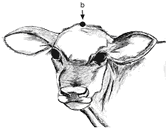
It requires a single firm blow to the front of the poll (see position 'b' in diagram) with a heavy blunt instrument. A short-handled club hammer, approximately 1.2kg with a striking face of 4cm x 4cm, is suitable.
The blow must be strong enough to fracture the skull and rapidly render the animal unconscious. The calf must be bled out immediately following the blow.
To ensure a humane death, you may only use this technique if you are sufficiently skilled. If you are not confident in your ability to deliver a blow of sufficient force, you must use another method.
Situations where the calf requires more than one blow to the head are unacceptable.
Bleeding out
Bleeding out involves severing the major blood vessels in the neck to allow free flow of blood.
To bleed out the animal:
- Make sure you use a sharp knife and make an incision at least 10cm long and 6cm deep in the neck.
- Make sure to cut both carotid arteries.
- Do not under any circumstances break or sever the spinal cord. This just causes more pain and also paralysis, which adds to the potential for stress.
© The State of Queensland 1995–2026