
Water planning framework
Water plans are developed under the Water Act 2000 to sustainably manage and allocate water resources in Queensland.
The water plan may apply to:
- rivers, lakes and springs
- overland flow
- underground water.
We tailor water plans for each plan area to balance the needs of:
- water users (e.g. towns, agriculture and other industries)
- the environment.
All water plans include unallocated water reserves which can be made available for future use without compromising the security of existing users or the environmental values within a catchment.
These reserves include Indigenous water reserves held for projects that advance the social and economic aspirations of Aboriginal people and Torres Strait Islanders.
This guide explains how water plans are developed, implemented, monitored and reviewed.
Stages in the water plan development process
Developing water plans
Stages of the development process
The development process generally includes the following stages:
- preliminary public consultation
- technical assessments (environmental, economic, social, hydrologic and cultural), policy development and consultation
- preparation of a draft water plan
- publication of draft plan and opportunity for public submissions
- consideration of submissions
- finalisation and approval of water plan.
When an existing water plan is reviewed, all these steps are done in full again.
Each stage might take a year or more. Developing or reviewing a water plan is a multi-year process.
Community input
We consult with a range of interested people including:
- regional communities
- Aboriginal and Torres Strait Islander groups
- conservation groups
- industry
- peak bodies
- water entitlement holders
- water service providers
- local government.
You should check your water plan area for any upcoming consultation.
Aboriginal peoples and Torres Strait Islander peoples
From October 2018, new or replacement water plans will explicitly recognise the importance of water resources for Aboriginal peoples and Torres Strait Islander peoples.
Cultural outcomes will be stated separately instead of being embedded in social, economic or environmental outcomes, and water plans will need to include strategies for their achievement, monitoring and reporting.
Water plan strategies and management actions
Water plan strategies are outlined in a water plan to help achieve its outcomes. These strategies guide how water is managed, shared, and protected to meet the needs of communities, industries, and the environment.
Management actions guide the implementation of these strategies and comprise rules for water use, limits on how much water can be taken and ways to protect water availability, access and quality. These are described in instruments like the water management protocol and water entitlement notice.
Water plan performance indicators
Performance indicators are hydrological statistics that represent water allocation security objectives and environmental flow objectives which are used to assess various development scenarios and applications. These indicators help guide decisions and ensure the plan outcomes are not compromised.
Technical assessments
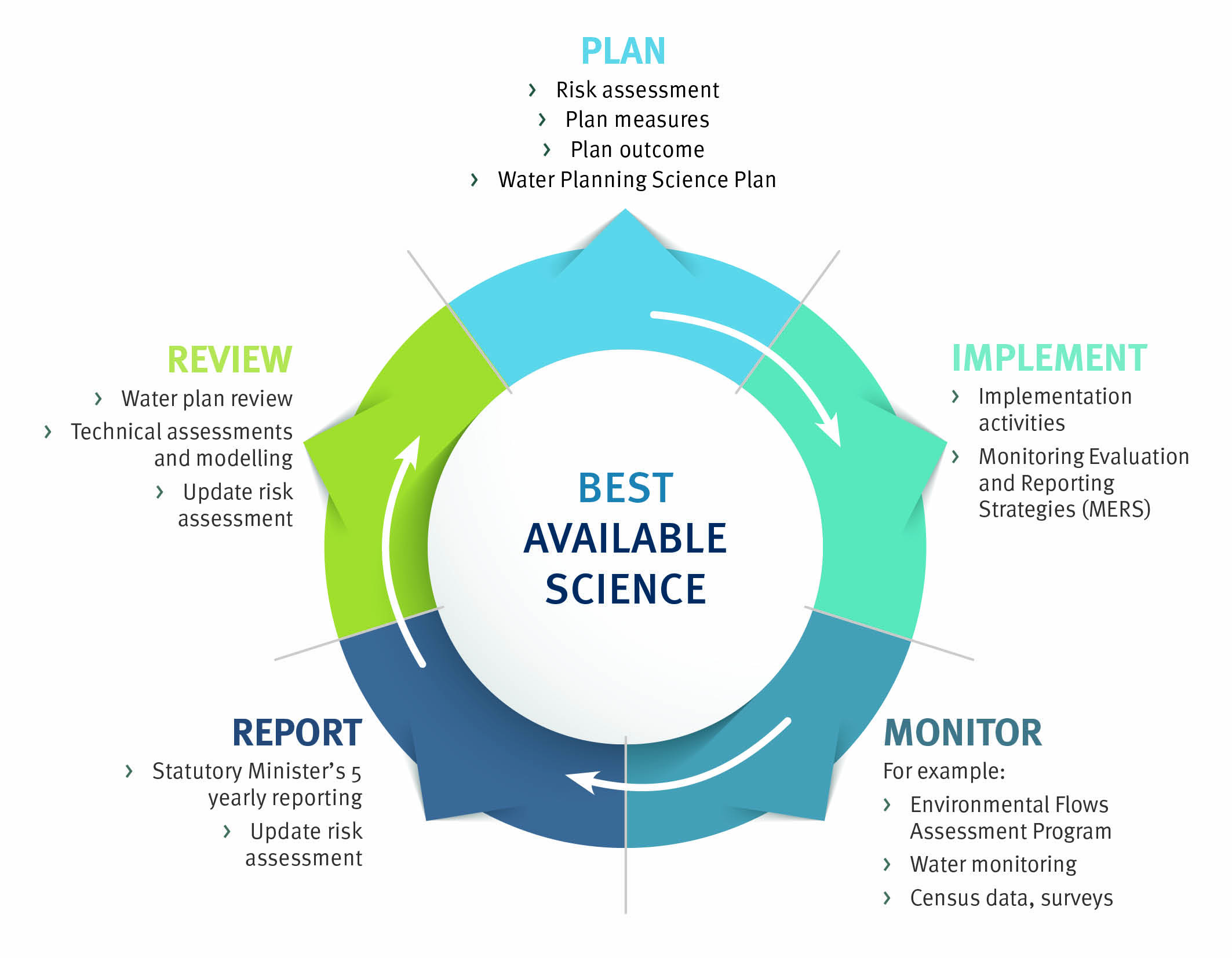
The best available science underpins the development of water plans. These technical assessments include:
- environmental assessments: ecological modelling using data collected on the flow requirements of ecosystems
- hydrologic assessments: models which draw on over 100 years of recorded flow data and represent a range of development, management strategy and climate impact scenarios
- social, economic and cultural assessments: identification of water related social, economic and cultural values.
Water plans consider information about historical rainfall, run-off information and water use. This helps us better understand and manage risks to water security, communities, and the environment. Strategies for managing climate-related risks may be included in water plans.
Collectively the assessments are important in determining the amount and type of water available so the water can be shared sustainably.
The Water planning science plan 2020–2030 explains how we use science to develop water plans and improve water planning. You can also explore the various ways we use science in water planning using our interactive storymap.
The Queensland’s water plans in a variable and changing climate report provides an overview of climate change modelling for water planning and climate change projections for individual plan areas.
Water assessment nodes
Water assessment nodes are nominal locations within a catchment that are identified in water plan hydrology models. These locations are used to establish and measure performance indicators.
Also consider...
- Find out how to request copies of hydrologic models and surface water data for your business.
- Access water plans and other planning documents for your water plan area.
- Read the Water planning science plan 2020–2030 to find out how we use science to develop water plans and improve water planning.
- Explore the various ways we use science to develop, monitor, review and evaluate our water plans using our interactive storymap.
- Read Queensland’s water plans in a variable and changing climate report to understand how water plans incorporate climate science and manage the risks of climate variability.
Implementing water plans
Water plans apply initially for 10 years after they've been approved.
During this period we undertake assessments of a plan's effectiveness. If necessary a water plan can be:
- replaced
- amended
- extended, for up to another 10 years.
Water plan documents
Water plans are implemented through a range of documents, developed in consultation with water users.
The table below explains each document.
Some water plan areas have yet to transition to the current framework. In these cases, resource operations plans remain in effect.
Queensland's water planning framework documents
| Current framework (as at Dec 2016) | Previous framework | Contents of new document |
|---|---|---|
| Water plans | Water resource plans |
|
| Water management protocols | Resource operations plans (ROP) |
|
|
Resource operations licences or Distribution operations licences |
| |
| Water supply scheme operations manuals |
| |
| Water entitlement notices | Conversion, granting and amending schedules in ROPs |
|
Also consider...
- Access water plans and other planning documents for your water plan area.
- Find out how to apply for a water licence and other water authorisations.
- Read about accessing water through water markets and trading.
- Find out where unallocated water is being released.
- Read the Water planning science plan 2020–2030 to find out how we use science to develop water plans and improve water planning.
- Explore the various ways we use science to develop, monitor, review and evaluate our water plans using our interactive storymap.
- Read Queensland’s water plans in a variable and changing climate report to understand how water plans incorporate climate science and manage the risks of climate variability.
Water plan monitoring, reporting and review
We monitor the implementation of each plan to make sure it's achieving its outcomes.
This includes using data from:
- streamflow gauging stations and groundwater monitoring bores
- the Environmental Flows Assessment Program (EFAP), which collects information on the water requirements of ecosystems to inform planning
- the Q-Catchments program (formerly known as the Stream and Estuary Assessment Program), which monitors threats to aquatic ecosystems
- expressions of interest in Indigenous water reserves.
We also use data from water supply scheme operators, who monitor and report on their infrastructure. Find out more about data collection and reporting standards.
Reports
The data we collect is used to:
- support the development of water plans
- prepare the Minister's reports.
The Minister's report is prepared at least every 5 years for the life of the plan. The reports are a water plan's 'health check'. You can download Minister reports from our library collection.
Reviews
Before a water plan expires, its performance is evaluated. This risk assessment helps determine if a plan can be extended, amended or needs a full review and replacement.
When an existing water plan is reviewed, all the plan development steps are done in full again.
-
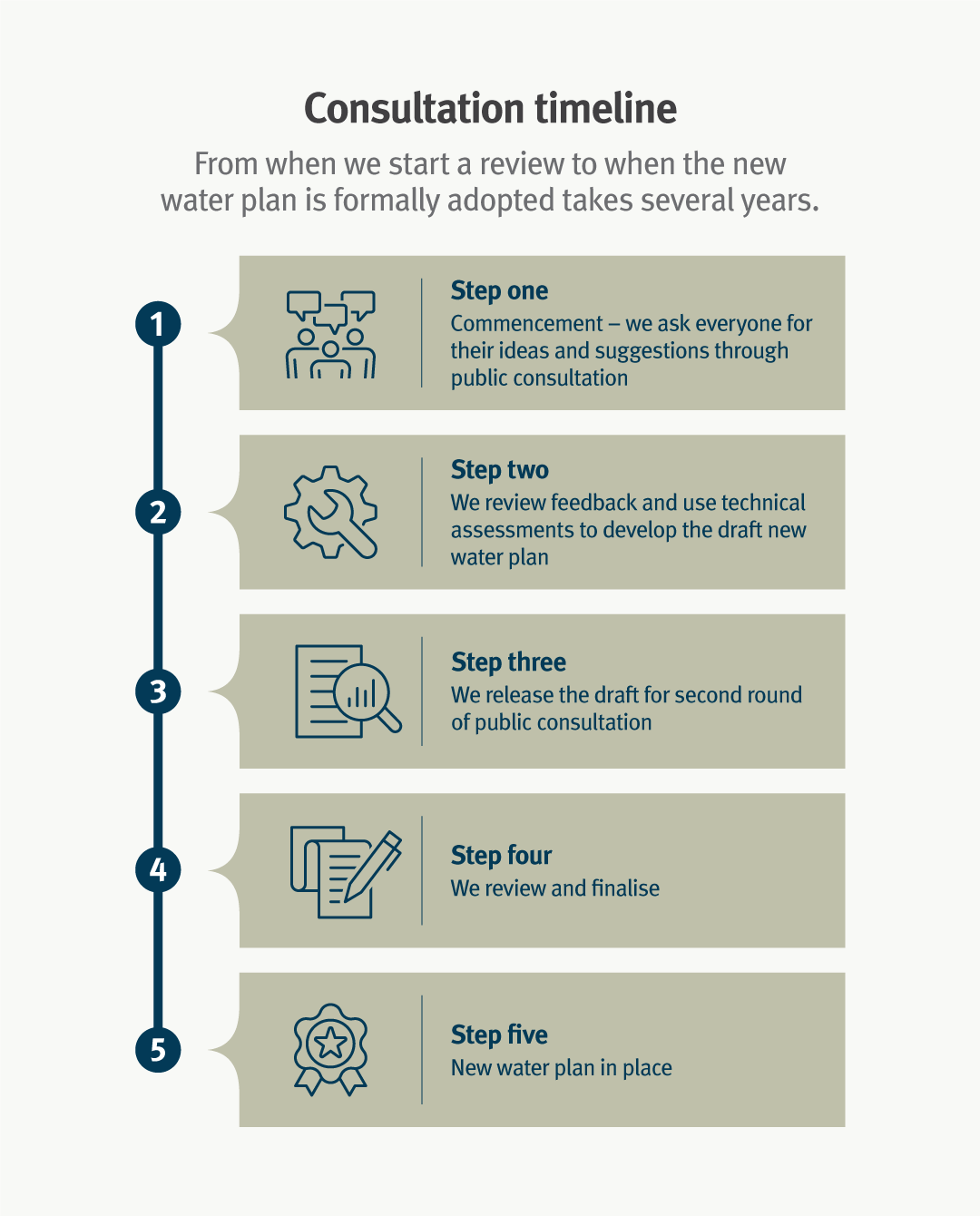
Consultation timeline
From when we start a review to when the new water plan is formally adopted takes several years.
- Step 1: Commencement - we ask everyone for their ideas and suggestions through public consultation.
- Step 2: We review feedback and use technical assessments to develop the draft new water plan.
- Step 3: We release the draft for second round of public consultation.
- Step 4: We review and finalise.
- Step 5: New water plan in place.
Current life stage for each water plan
See where each water plan is in its own cycle. This is separate to the unlocking water project.
Current
- Baffle Creek Basin (expiry 2030)
- Barron (expiry 2033)
- Cape York (expiry 2029)
- Cooper Creek (expiry 2031)
- Mary Basin (expiry 2034)
- Wet Tropics (expiry 2032)
- Queensland Murray Darling Basin
- Border Rivers and Moonie (expiry 2029)
- Condamine and Balonne (expiry 2029)
- Warrego, Paroo, Bulloo and Nebine (expiry 2026)
In review
- Burdekin Basin (expires 2028)
- Burnett Basin (expires 2027)
- Georgina and Diamantina (expires 2027)
- Gold Coast (expires 2026)
- Gulf (expires 2027)
- Logan Basin (expires 2026)
- Mitchell (expires 2027)
- Moreton (expires 2029)
- Pioneer Valley (expires 2027)
- Whitsunday (expires 2028)
- Great Artesian Basin and other regional aquifers (GABORA) (expires 2027)
- Proposed Central Queensland Water plan (proposal to combine 3 existing water plan areas)
- Boyne River Basin (expires 2028)
- Calliope River (expires 2028)
- Fitzroy Basin (expires 2028).
Also consider...
- Access water plans and other planning documents for your water plan area.
- Visit the water monitoring portal for information on streamflow and groundwater levels.
- Find out more about Indigenous water reserves.
- Find out more about the water monitoring and data and the Environmental Flows Assessment Program.
- Read the Water planning science plan 2020–2030 to find out how we use science to develop water plans and improve water planning.
- Explore the various ways we use science to develop, monitor, review and evaluate our water plans using our interactive storymap.
- Find out about water metering and how metering data is used to measure water use.
- Read about how we monitor and evaluate water use to ensure compliance with water regulations.
- Read Queensland’s water plans in a variable and changing climate report to understand how water plans incorporate climate science and manage the risks of climate variability.
© The State of Queensland 1995–2026