
Adapt and change your business
Guide Printing
Learn how to pivot, adapt or transform your business when you need to respond to change.
Use our step-by-step process to discover if you should:
- improve your business operations
- develop new products and services
- adopt a new business model
- target new customers.
Change process overview
Step 1 – Prepare your business for change
Read what to do before you start adapting your business operations. Prepare yourself, your team and your business, and complete the business model canvas.
Step 2 – Understand how to change
Understand what change means for your business. Identify trends and shifts to guide your decisions. Review external trends with the context map canvas.
Step 3 – Manage change
Find out how to make the most from trends and opportunities around your business while addressing weaknesses or threats. Identify these using the SWOT canvas.
Step 4 – Make change happen
Start putting your change plans for your business into action. Create a change readiness plan and find support and resources to implement your changes.
Step-by-step change planning process
Create a plan to manage change and save your business time and effort, improve outcomes and reduce risk.
Use our activities and resources to help shift or grow your business in good times, or when things get tough.
-
One. Adapt and change your business.
As a business owner, you probably know that change is inevitable and happens constantly.
Change could mean new competition for your products or services or changes to your customers' tastes and needs.
Change is happening all around us. How you respond to change can be a key factor for how successful your business will be.
It's fair to say that with natural disasters, a global pandemic and a digital revolution, we've all had to face up to the challenges that change can bring.
But what if there was a way to work through change that reduces anxiety, brings more certainty, maximises the impact of your time and effort, and improves your business outcomes?
Welcome to our resource hub to help your business change and adapt. Whether you are looking to improve your current business or invent a new one, this resource is designed to provide tools and information to help you plan, manage and respond to change in the most effective way, even if that change is unexpected.
Why do we need to change? As the old adage goes, if it ain't broke, don't fix it, right? Unfortunately, by the time you realise your business is out of step with customers, competitors or market needs, it might be too late to fix it.
That's why it's critical to prepare for, understand and know how to manage change.
So what is change? Change is a general shift of something from one state to another state.
In business, this often means a shift in external factors like an economic downturn, increased competition or shifts in customer demand, or internal factors such as production processes, your location, what you sell or staffing levels.
Any of these factors can affect how you conduct business. You can't change external factors that come your way, but the internal factors are where you can have significant control.
Managing change means adapting or pivoting your business's internal elements that make up your business model.
Understanding your business model and tweaking it to accommodate change as you see or expect is the key to running a successful business in today's world.
You'll need to have a pro-change attitude and a clear understanding of your values and your personal and business goals.
To support you along the way, we've put together this series of videos and resources to help you prepare for change, understand change, manage change and make change happen.
Along the way, we'll explore your business's strengths, weaknesses, opportunities and threats to help you adjust your business model for success.
Work through the change program at your own pace and take the time to download and use the tools given to you along the way.
This will help you master change and potentially even find a way to shift your business into a higher gear.
Step 1 – Prepare your business for change
On this page
Turn on this option to focus on essential topics and actions in this step and hide optional parts.
- Introduction to change
- Prepare yourself for change
- Prepare yourself for change – using the personal business model canvas
- Personal business model canvas
- Prepare your team
- Storytelling canvas
- Prepare your business
- Prepare your business for change – using the business model canvas
- Business model canvas
Change in the world around your business can happen quickly and without warning. It can be time-consuming and expensive to adapt your operations once you realise your business is no longer meeting the needs of your customers and has fallen behind your competitors. That's why it's critical to prepare for, understand and know how to manage change.
Start by understanding where you are today – both for yourself personally as a business owner, and for your business. You'll be better prepared to adapt your business in the smartest possible way if you clearly understand how you and your business operate right now.
This step will help you understand:
- the role you play in your business
- how to better understand your business operations.
Introduction to change
Essential
-
Always look for ways to adjust and develop your business in response to change.
When the external environment around your business changes, you'll need to adapt the internal elements of your business as well. These elements make up your business model.
If you can successfully respond to these external trends with internal changes, you will create value for your customers, and in turn for your business and yourself.
-
The 2 main forces that affect change are:
- external factors, like an economic downturn, new competition and changing customer demand
- internal factors, such as staff development, systems and processes.
Change can also be:
- proactive, where you make the decision to change something you can control, such as your products and services
- reactive, where you are forced to respond to something unforeseen, such as a new regulation in your industry.
-
To best manage change in your business, you must feel confident to make decisions during uncertainty.
This means taking control of the things you can change (internal factors) and accepting there will be things you can't change (external factors).
Planning ahead and researching trends can help you to control how change affects your business.
Why your business might need to change
Changes in the world around you can affect many areas of your business. Consider what your business would do in these scenarios.
-
A global pandemic has hit, and your business storefront needs to close temporarily. Your customers can't access your products and services.
- How can you make sure your customers can still access your products and services?
- How can you retrain and redeploy your staff so they can still support you, and you don't have to let anyone go?
- Can you develop new products and services to meet changing needs and demands of your customers?
-
Your customers are increasingly conscious of the environmental impacts of what they buy. You notice new, successful competitors emerging that focus on providing sustainable products and services.
- How can you make sure your products are meeting the expectations of your customers?
- Are there other areas of your business you can adapt to introduce sustainable practices (e.g. lowering your water and power usage, or managing your levels of waste)?
- How can you better promote the benefits of your products to your customers?
- Do all of your customer segments have the same values, needs and expectations?
-
Your key customer group is university students, but you find out the local campus is closing. Without the university nearby, it's unlikely your regular customers will need to visit your local area anymore.
- What other customer groups live in or visit your local area?
- Will these other customer groups have a need for your products?
- How can you shift your products and services to appeal to new customer groups?
- How will you need to change your communication channels to access different customer groups?
- How can you find out what the university site will be used for next? Is there potential to start developing new products and services for a new market that might use the site's planned facilities?
Prepare yourself for change
Preparing yourself as a business owner or leader is just as important as preparing your team or preparing your business. You must have a pro-change attitude to succeed.
Make the change personal and focus on yourself first. Consider why you're in business, and where you want to go as you work through your change journey. Work out what skills you have and the personal values you bring to your business – this will help you to work out what’s missing and what to focus on.
Watch our video to learn how to complete the personal business model canvas and find out the value you bring to your business.
-
Two. Prepare for change.
In the same way that you might plot your destination into a GPS before setting off on a new journey, preparing for change is a similar process.
Getting your business ready for change starts with preparing yourself for where you want to go, preparing your team and preparing your business.
Start by preparing yourself for change.
How willing are you to shift your own attitude towards being pro change? This is an essential key to success.
To set yourself up for success, it helps to make the change personal by considering why you are in business in the first place and where you want to go.
The personal business model canvas is a great tool to help you understand your value and the skills you have to work through change. It will also help you determine your personal goals in a simple and structured way.
The personal business model canvas can help you consider the reason you went into business in the first place.
Use this template to describe who you are. It will help you explore what being in business really means to you.
Work through each of the boxes to answer questions about, one, who you are and what you're good at.
Two, what you do and what's different about your work compared to others.
Three, who you help or who you give value to.
Four, how you help others and what problems you solve for people.
Five, how people know you and how you deliver what you do.
Six, what role or responsibility you play with different clients or customers.
Seven, who you can call on to help you.
Eight, what you get for your work, whether it's a salary or other benefits.
Nine, what you give or what it costs you to deliver your value to others.
Take a moment now to download and complete this tool.
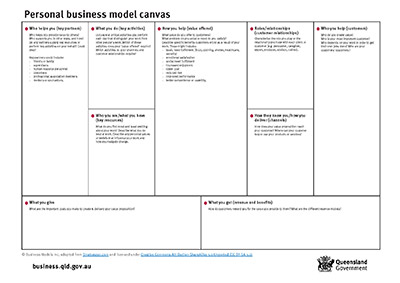
Complete your personal business model canvas
The personal business model canvas will help you:
- understand the skills and values you bring to your business
- determine your personal goals in a simple and structured way.
Download the personal business model canvas template.
This tool is adapted from strategyzer.com and licensed under Creative Commons Attribution-ShareAlike 3.0 Unported (CC BY-SA 3.0).
Prepare your team
Once you're clear on your personal objectives, plan how you're going to prepare your team for change.
Your team could find change to be confronting and intimidating, or exciting and rewarding. It's important to communicate and work together to effectively manage changes as a team.
A positive attitude towards change from you and your team will make your business more resilient and give you a greater chance of success.
To do this, start by explaining:
- the reasons for the change
- the benefits or aim of the change
- how you expect the change process to work
- what you want to achieve.
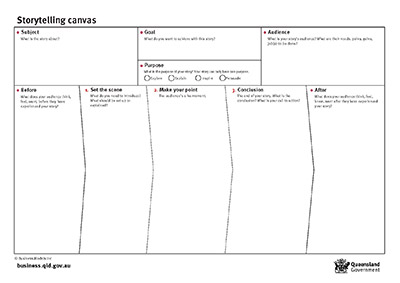
Complete your storytelling canvas
The storytelling canvas will help you:
- prepare your team for change
- construct a story to share knowledge and information that your team can understand and care about
- design your change story in your own time, or collectively with your team, using visual and engaging elements.
Download the storytelling canvas to fill out and save for future reference:
This tool was created by Business Models Inc in the book Design a Better Business (Van Der Pijl, P., Lokitz, J., Solomon, L., Van der Pluijm, E., & Van Lieshout, M. (2016). Wiley.).
Prepare your business
Essential
Prepare your business for change by using the business model canvas. The canvas is a popular tool used by businesses of all sizes around the world and will demonstrate how your business works, and how it might be impacted by change.
Watch our video to learn how the business model canvas can help you explore how your business operates.
-
Three. Business model canvas.
Businesses around the world use the business model canvas to understand, change and improve their operations.
Regardless of the size or industry sector of your business, it provides a 1 page overview of how your business works.
To better understand this tool, let's look at how it works with a business example we can all understand.
This is Penny, and her business is a lemonade stand.
Penny knows that being open to change will build the resilience of her business, whether she's proactively changing or reacting to something unexpected.
Listening to her team and talking with them will help her develop better ideas on adapting her business.
Prepare your business for change by using the business model canvas.
This tool helps you capture how your business currently works, what changes might be needed, how these changes might impact your business model.
A business model is simply a plan for how your business makes money and how all the components of your business work together.
Let's understand Penny's current business model using the business model canvas.
The business model canvas is essentially a 1 page business plan. It's made up of 9 areas that describe who your customers are, how you provide products or services and how you create revenue.
Let's take a closer look at Penny's business.
First up, customer segments, which is a list of all the people or groups your business aims to reach and serve. In this case, neighbours, passers-by and friends.
The value proposition describes what value you provide to each of the customers you've identified. Penny's value proposition is refreshing lemonade.
Channels describe how customers access your products or services and how you deliver your value proposition. Penny sells to her customers using a booth or lemonade stand.
Customer relationship describes how your business establishes and maintains a lasting relationship with your customers. Penny plans to sell to passers by and personal contacts of her and her friends whom she's recruited to help her.
Revenue streams describe the way your business will make money. Penny's revenue stream is charging 1 dollar per cup of lemonade.
Key resources describe the most important assets you'll need to make your business work. Penny's got a lemon tree in the front yard, she's also got her dad's secret recipe. With a table and chairs, some cups and some friends, she's got the key resources she needs.
Key activities describe the most important things you must do to make your business model work. In other words, what do you do every day to run your business? Making lemonade is a key activity, so is operating the lemonade stand and putting up posters around the neighbourhood.
Key partners are the network of suppliers that make the business work. Key partners are other businesses that allow your business to do what it does without having to develop or own everything. For Penny, the sugar, ice and cups come from a supermarket.
Costs describe the underlying expenses to run your business, including the key resources, activities and partners. Penny gets free lemons from her tree, but will have to buy sugar, ice and cups, which is a cost. She will have to split her profits with her helpers.
Download and complete your business model canvas now. Consider each of the sections of the canvas and document how your business currently works.
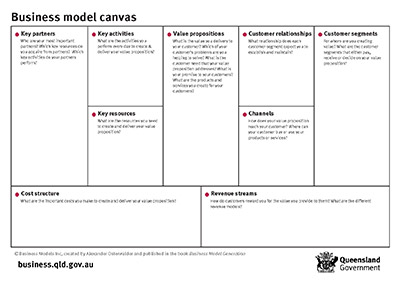
Complete your own business model canvas
The business model canvas is a template with 9 interconnecting sections that describes how your business works. It captures who your customers are, how you provide products or services and how you create income.
Use the canvas to learn about:
- the customers you serve
- what products and services (value propositions) are offered through what channels
- how your business makes money.
You can use the business model canvas to understand your own business model or one of a competitor.
Download the print-optimised versions of the business model canvas to fill out and save for future reference:
- A4 business model canvas template
- A3 business model canvas template
- Example completed business model canvas.
You can also use our interactive business model canvas.
This tool was created by Alexander Osterwalder and published in the book Business Model Generation (Osterwalder, A., & Pigneur, Y. (2010). John Wiley & Sons.).
What's next
Once you've completed your business model canvas to show how your business runs today (and your own personal business model canvas) you can better understand how your business can change.
In step 2 we'll explore how you want your business to develop, how change might impact your operations, and how you can respond to change now and in the future. This process is called business model innovation.
You'll be invited to return to your original business model canvas to review how the changes you're planning might affect other segments on your canvas.
- What might need to change in your business model over the next 1, 3 or 5 years?
- What improvements could you make to each of your business model segments?
- Are there elements in your business model that are making change difficult?
- Can you decrease costs by bringing on a key supplier or partner?
- Can you add new channels to access different customer segments?
Think through each segment to identify where you can innovate and create a stronger and more resilient business. In the next step, you'll learn how to make sure your business model innovation has the highest chance of success.
Before you consider making changes to your business, make sure it's operating efficiently.
Take our business health check to find your business's strengths and areas for improvement.
Also consider...
Step 2 – Understand how to change
On this page
Turn on this option to focus on essential topics and actions in this step and hide optional parts.
- Understand external change
- Understanding external change – using the context map canvas
- Context map canvas
- Understand internal change
- Understanding internal change – how to manage change you can control
- Update business model canvas
- Understand what matters most
- Design criteria canvas
Understanding change is about being aware of how the world you work in is constantly shifting and adapting. You then need to review how this could affect your business.
It's important to know the context of where and how your business sits within the changing world.
Think of change as a journey:
- Preparing for change determines where you want to go.
- Understanding change identifies how to best get there.
The drivers of change for your business can be:
- internal 'shifts' to your business model
- external 'trends' in the world around your business.
Understand external change
Essential
You must understand and respond to external change for your business to be successful. External trends are often out of your control, but you can control how they affect your business.
Learn to anticipate and develop responses to these external change trends – such as providing a mobile-friendly website to reflect the external trend of customers wanting to shop for your products anytime and anywhere.
You should regularly adjust and develop your business according to trends in the external environment.
-
The global coronavirus (COVID-19) pandemic provides many examples of external change that affected businesses.
- State and international border closures causing loss of interstate and overseas customers, supply chain and transport issues affecting stock levels.
- Increased health requirements requiring staff retraining and more time spent on cleaning.
- Unexpected lockdowns leading to loss of staff, cash flow issues, loss of stock, customers can’t access products and services.
Other examples of external change:
- Natural disasters causing property and equipment losses, supply chain disruptions and staff not being able to access your premises.
- Increased environmental awareness with customers becoming more interested in sustainable, environmentally-friendly products and services.
- Rapid advances in technology meaning more competition for your business, customers expecting to access your products and services from anywhere, and the risk of products becoming outdated.
- Demographic and social change which changes customer demand for products and services
- Competition in your industry or location leading to a major shift in demand for your products and services.
-
- Listen to your customers – what are they saying about your products and services? How are their needs changing?
- Talk to your suppliers – are there new materials, products or equipment on offer? What trends are they noticing in the market?
- Keep up with the news – what is happening in your local area, around Australia, and internationally?
- Tap into industry knowledge – what is your industry association or peak body currently researching?
- Monitor your competitors – how are other businesses changing to offer new and improved products and services?
Learn more about market and customer research.
Watch our video to learn how changes happening in the world around your business can affect your operations.
-
Four. Understanding external change.
Whether you're planning a global business or a local start up, it's important to know there are things you can and can't control.
It can help to think of external factors as market trends. While trends themselves are often out of your control, your ability to understand trends and how they could affect your business is not.
The challenge is to use trends to your advantage by learning to anticipate and quickly respond to them.
To understand the concept of external change, let's go back to our simple example of Penny's lemonade stand.
For Penny, winter is coming and the lemonade stand is not doing as well as it used to.
Some changes you make might fail, but some will succeed. It's your job to adjust and develop your business according to what's happening around you.
New ideas won't always work, so introduce changes on a small scale as quickly and as cost effectively as possible before you commit to larger, more expensive changes.
When it comes to understanding external change, use the context map canvas to help you and your team expand your thinking beyond your current products and services.
For Penny, the economic and environmental realities are clear. With winter coming, there's less foot traffic and customers prefer to stay indoors.
Looking at technology trends, we see that the demand for lemonade has shifted to buying online. Customers want the convenience of making their own lemonade at home.
Penny's lemon tree is also extremely low in fruit. Penny doesn't know whether the tree will be able to supply enough lemons in the future.
She needs to think about these external factors if she wants to continue selling lemonade.
The context map canvas will help you identify what's going on in the world and what's changing that will affect your business today and in the future.
It will help you understand the impact of external change both in opportunities and threats.
Download the tool and think about external factors that might affect your business. Discuss this with your team or friends or family who understand your business.
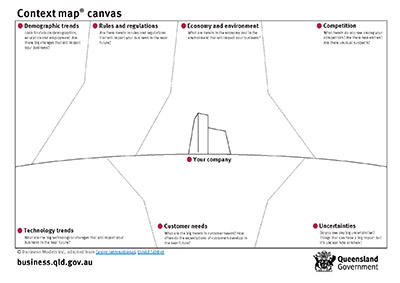
Complete your context map canvas
The context map canvas will help you:
- expand your thinking beyond your current business model
- understand what's happening in the world around you right now
- learn what changes could affect your business in the near future.
Add a date to your canvas to help you focus on what's happening now, rather than exploring too far into the future.
Download the context map canvas to fill out and save for future reference:
This tool was created by David Sibbet of Grove International, and adapted by Business Models Inc. in the book Design a Better Business (Van Der Pijl, P., Lokitz, J., Solomon, L., Van der Pluijm, E., & Van Lieshout, M. (2016). Wiley.).
Understand internal change
Essential
Internal change is driven by decisions and actions you take in your business. These decisions and changes are something you can control.
Think of internal change as shifts to your business. These shifts could be either:
- immediate change, such as updating technology to improve your operation, or a restructure due to rapid growth or decline in your business
- longer-term change, such as how you respond to changes in customer expectations, attitudes and behaviours, wants, needs and desires.
-
- Your people – key staff members with valuable skills and experience can be difficult to replace. You may need to take a new direction with recruitment and staff operations, such as re-skilling and training employees, outsourcing tasks or making changes to roles and responsibilities.
- Your property – changes to your business's location or premises to expand your capacity, support new processes or to access new customers and clients.
- Your channels – taking your website from a simple promotional tool for your business to a dedicated sales channel could help you grow your revenue and reach customers who can't visit your premises.
- Your processes and systems – a new piece of equipment or updated technology could have significant benefits for how your business operates. This could be a new customer relationship management system that changes how you interact with your customers, or changes to a manufacturing process which affects your product range or production capacity.
Watch our video to learn why it's important to adapt your internal business operations to respond to changes happening in the world around your business.
-
Five. Understanding internal change.
Regardless of the size of your business, whether you're a local business or even if you're setting yourself up for global expansion, understanding that there are changes you can make within your business is critical to your success.
Internal changes are decisions you make within your business, and these decisions are something you can control.
Penny has just completed her context map canvas, which has helped her identify changes happening in the world around her business.
She realises that her market has changed and that she needs to make some changes too.
Think about the context map canvas you've completed and how the shifts you identified could affect your business. Update these on your current business model canvas.
In Penny's case, there's been a run of bad weather and other reasons why less people can visit her stand. So she needs to make some internal changes to her business.
Penny adds online customers to her customer segments.
Because of this, she has to change her value proposition to selling lemonade syrup.
This has also meant her channel to customers has to change to an online store with home delivery.
She's also refocused her customer relationship efforts to a friendly online experience and trained her friends to provide excellent phone support.
With her lemon tree now very low in fruit, this has caused some risk to her key resources, she must investigate a more consistent supply of lemons.
Instead of table, chairs and cups, she'll need to investigate bottles and packaging options.
Her research and development team will also need to adapt her lemonade recipe to a lemonade syrup.
Her friends will need to be retrained to help package the syrup for post.
Under key partners, Penny has found a wholesaler for sugar and lemons, which reduces costs.
Under cost structures, Penny no longer needs posters and cups, but will need to pay for the online store and online ads to get her products seen. She must also allow for postage and packaging.
For revenue, the price per cup has been replaced with price per bottle and per dozen. She's also offering a lemonade club subscription where customers receive 2 bottles per month delivered without having to reorder, creating convenience for customers and also a more consistent revenue model for Penny.
Penny takes a look at how her changes are making an impact on her business. She notices her sales have increased, which means her profits are rising too.
Revisit your own business model canvas. Have a think about the 9 areas on your canvas with a fresh lens.
What internal changes might help shift your business into a higher gear?
How will changes to parts of your canvas affect the other parts?
Are there opportunities to improve your business or create more efficiency?
Identify the right change for your business
Identifying these shifts is key to the performance of your business and your ability to manage change. They'll help you work out how you can provide a more attractive product or service to your customers, and ensure your business stays relevant.
You can identify shifts in your business by revisiting your business model canvas. For example, a shift in your:
- customer segments might help you see new customer opportunities you didn't see before
- customer relationships or channels to the customer can help you better service your customers, or reduce the chances of channels to customers becoming outdated
- value proposition could help you improve your product or services, or reduce the impact of a competitor offering better value
- operations, key resources, key activities or key partners could lower the risk of losing a key partner, or uncover opportunities to improve efficiencies
- financial model, your revenue model or cost model could diversify revenue, or address a threat of costs that might blow out in the future.
These shifts can be small adaptations within your existing business model. They can also be larger, transformational shifts, where bold changes are needed to help your business pivot into a completely new business model.
Revisit your business model canvas
Go back to your business model canvas you completed in step 1.
- Look at the trends you've identified in your context map canvas.
- Work out how these trends affect each of the segments on your business model canvas.
- Update your business model canvas to reflect your new or changing market.
This is where you'll start mapping the changes you want to make to your business. It will help you to understand what internal shifts you'll need to consider to help make the change successful.
Understand what matters most
You've now identified the external trends happening around your business, and what internal shifts you need to consider based on these trends.
Before you start making changes to your operations, you'll need to decide which ones:
- align with the vision you have for your business
- meet the expectations of your customers
- provide the most benefit for your business.
Consider what you must do, should do, could do, and won't do when you're deciding what changes to respond to, and what actions you'll take.
Develop a set of decision criteria that outline what matters most for you and your business using the design criteria canvas. These are the principles and standards behind how you run your business and how you'll approach your response to change.
-
Must do
- Sustainable and eco-friendly
- Improve staff wellbeing
- Support local suppliers and small businesses
Should do
- Equipment lasts for more than 10 years
- Pricing similar to existing products
Could do
- Integration with existing systems
- Borrow funds or seek new investment
Won't do
- Compromise staff safety
- Products manufactured overseas

Complete your design criteria canvas
The design criteria canvas can help you:
- make better decisions for how you action change
- consider the criteria for making change decisions.
Download the design criteria canvas to fill out and save for future reference:
This tool was created by Business Models Inc in the book Design a Better Business (Van Der Pijl, P., Lokitz, J., Solomon, L., Van der Pluijm, E., & Van Lieshout, M. (2016). Wiley.).
Also consider...
- Learn about ways to measure customer service, including mystery shopping, surveys and feedback forms.
- Find out how to research your market.
- Complete a competitor profile chart to assess your competition.
- Read about creating business values.
- Watch our Lean your business webinar to learn about the 'lean' approach to making continuous improvements, increasing productivity in your business and creating more value for your customers.
Step 3 – Manage change
On this page
Turn on this option to focus on essential topics and actions in this step and hide optional parts.
- Assess and manage external and internal change
- SWOT canvas
- Know what to action first
- Trend canvas
Learning how to manage change is an important part of running a successful business.
So far in your change journey you will have:
- prepared for change by reviewing your personal goals and skills, engaging your team and identifying the type of change you need to action
- understood how to change by identifying external and internal changes relevant to your business.
The next step is to understand what will drive the performance of your business. This will help you know how to manage change.
Assess external and internal change
Essential
Learn about identifying your business's strengths, weaknesses, opportunities and threats, and complete a SWOT analysis activity to plot your path towards positive change.
SWOT analysis
A SWOT analysis will help you identify your strengths, weaknesses, opportunities and threats. It will show you:
- exactly how and where change may impact your business
- the decisions that are the most important for reducing risks
- how to improve the likelihood of successfully navigating change in your business
- what the world looks like in the future to assess the potential for future change or disruption.
Use information from the activities you've already completed to help you fill out your SWOT canvas.
- Your business model canvas will help you identify the strengths and weaknesses of your business.
- Categorise items from your context map canvas as either opportunities you can take advantage of or threats you need to shield your business from.
If you're facing a crisis from one particular threat (e.g. the COVID-19 pandemic), adapt your SWOT analysis to focus on that threat alone. Look at the strengths you can leverage, and the weaknesses you'll need to address. You can then come up with opportunities you can capitalise on.
-
What does your business do well? What are you proud of as a business owner? What keeps your customers coming back?
Use these examples to start exploring the strengths of your business.
- Large, loyal customer base generated over many years
- High quality products developed from years of testing and customer feedback
- Great customer service with many positive reviews
- Good relationships with suppliers that attracts loyalty discounts and mutual understanding during challenging times
-
What doesn’t your business do well? Where do you see room for improvement?
Use these examples to start thinking about your business's weaknesses.
- High production costs due to small product runs and not operating 24/7
- High staff turnover meaning additional training costs, reduced staff output and loss of experience and knowledge
- Lack of IT knowledge to feel confident in running online operations and managing social media
- Stagnant customer growth meaning little chance of increasing profits
-
What upcoming trends do you predict your business could take advantage of? What changes have you noticed in your market that could result in more business?
Use these examples to start thinking about the opportunities your business could take in the future.
- New technologies which could reduce production times and still produce high-quality products
- Different types of customer groups emerging in your local area
- Changing customer attitudes like support of local businesses, and appreciation of environmentally-friendly products
-
What potential trends or changes in your market are you concerned about? What obstacles or barriers will your business face in the future?
Use these examples to start thinking about potential threats to your business.
- New products from competitors that could make your products outdated or irrelevant
- Supplier shortages meaning you can't access key materials
- Economic situation changes with key customers no longer able to regularly afford your services
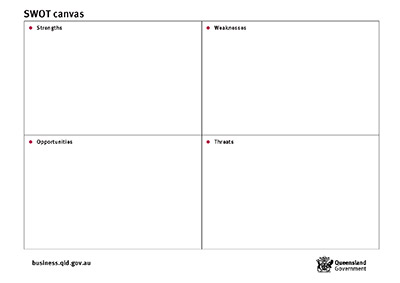
Complete your SWOT analysis
Use the SWOT canvas to analyse your business's strengths, weaknesses, opportunities and threats.
Download the SWOT canvas template or use our interactive SWOT analysis tool.
How to manage external and internal change
Managing change is key to ensuring a healthy business. Over time, you will develop an understanding of what you can and can't control.
To manage externally-driven change, you'll need to:
- anticipate opportunities and threats
- respond quickly to trends outside of your control
- proactively create opportunities
- reduce and eliminate threats.
Keep your SWOT canvas up to date and regularly review the opportunities and threats that may impact your business. From this, you can work out what internal shifts you can make to your business model to capitalise on opportunities and offset any threats.
When approaching any internal change, look at your business's strengths and weaknesses. Knowing how to work to the strengths of your business while reducing the impact of any weaknesses is key to managing the change itself.
Don't forget to consider the decision criteria you developed in your design criteria canvas. Make sure any internal shifts you plan to make are aligned with your must do or should do criteria.
This will mean you can:
- react faster to unforeseen change
- proactively shift your business to
- improve an existing strength or build a new one
- reduce or eliminate a weakness.
Know what to action first
Change will continually affect your business over the coming weeks, months and years. Prioritise your responses and actions to increase the likelihood of successfully managing change in your business.
After completing the SWOT canvas, you'll have a good idea of the opportunities and threats around your business. You must then work out which of these trends are likely to impact your business immediately, and which ones you have more time to plan for.
Complete a trend canvas to map out a timeline for when your identified opportunities and threats will impact your business.
Once you start to develop your actions in response to change, you can also plot your actions onto the trend canvas.
This will help you work out how soon you must take action, and what's possible in the time you have available.
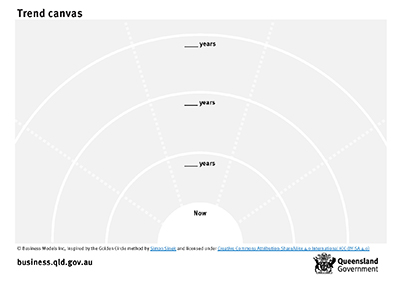
Complete your trend canvas
The trend canvas will help you:
- map out when the external trends you've identified are likely to impact your business
- create a clear timeline for the internal actions you're taking to respond to each trend.
Download the trend canvas template.
This tool is inspired by the Golden Circle method by Simon Sinek and licensed under Creative Commons Attribution-ShareAlike 4.0 International (CC-BY-SA 4.0).
Step 4 – Make change happen
On this page
Turn on this option to focus on essential topics and actions in this step and hide optional parts.
- Change readiness plan
- Change readiness plan
- Change checklist
- Start taking action
- Resources to support your change action plan
It's time to put your plans into action.
Review your outcomes from the activities you've completed and start to work out the actions you'll take. Use our list of suggested resources to help start implementing your change plans.
Change readiness plan
You can now create your change readiness plan. The plan captures the work you've completed across the 3 steps of your change journey so far.
Update your plan as your business identifies and makes changes. This will ensure it's always relevant and focused on the outcomes you want.
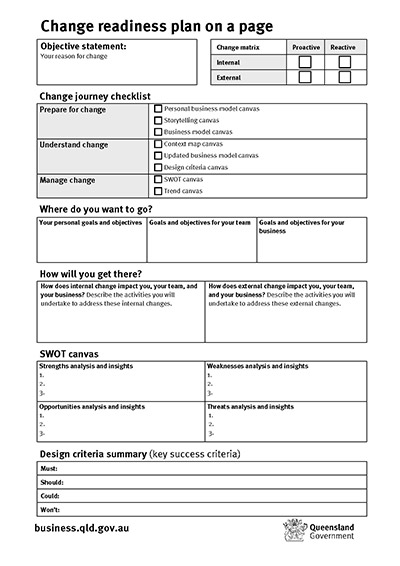
Complete your change readiness plan
The change readiness plan will help you put all your outcomes in a single document to help you start taking action.
Download the change readiness plan template.
Change checklist
Review which tools and activities you've completed in your change journey so far.
Start taking action
Essential
Use the insights you've gained from the planning tools and start adapting and changing your business.
Treat your completed templates as living documents – update them regularly as your business changes and grows. Look out for emerging external trends and new opportunities and threats. By doing this, your business will be better positioned for success and you'll be primed to take action when you need.
Resources to support your change actions
Find information and support to help you start making changes to your business operations.
- Develop new products or services
Find out the process for new product development – from idea to implementation.
- Find new customers
Discover techniques to find new customers, generate sales and renew sales to former customers.
- Customer and market research
Find out how to define your market and conduct different types of market research.
- Use business advisers
Find the right business adviser and build a successful working relationship with them.
- Pricing products and services
Learn how to set the right prices for your products and services.
- Do business online
Read how to get your business online, including legal and security considerations.
- Business mentoring
Learn the benefits of working with an experienced business mentor, and how to find one.
- Export
Discover how to grow your business by exporting. Find support to enter global markets.
- Develop staff
Develop the skills and capabilities of your staff, and learn how to manage your team through change.
- Lead through change
Learn about different leadership styles and how they affect staff, clients and business.
- Find suppliers
Read how to find the right suppliers and negotiate contracts.
- Find the right premises
Learn about finding the best location for your business.
Support and advice
- Phone 13 QGOV (13 74 68) for information on programs, grants and services for Queensland small businesses.
- Register with Mentoring for Growth for a free session with an experienced business mentor.
- Find out if you're eligible for any small business grant programs.
- Find resources to support your mental wellbeing and the wellbeing of your staff.
Toggle container
Turn on this option to focus on essential topics and actions in this step and hide optional parts.
© The State of Queensland 1995–2026