Request and assessment—Voluntary assisted dying process Guide
Before you can access voluntary assisted dying, you must make 3 separate requests.
There must be at least 9 days between the first and final request. This period allows time for you to reflect on your choices while ensuring your suffering isn’t drawn out.
The 9-day period can be shortened if your coordinating and consulting doctors both believe that you are likely to die or lose decision-making capacity during that time.
First request
Only you can make a request for voluntary assisted dying, your family and carers cannot request voluntary assisted dying on your behalf.
You ask a doctor for access to voluntary assisted dying. This is the first of 3 requests.
The request must be:
clear and unambiguous, so your doctor knows exactly what you are asking
made by yourself and not by another person on your behalf
made verbally or by other means of communication such as gestures.
If you choose to start the voluntary assisted dying process, you should make your request to your doctor during a medical consultation. This can be in person or via telehealth.
Not all doctors provide voluntary assisted dying services, but all doctors have legal obligations.
The Voluntary Assisted Dying Act 2021 (the Act) states that if a doctor chooses not to be involved, they must give you information about other doctors or services who may be able to help you access voluntary assisted dying. A doctor can refuse your request if they:
have a conscientious objection—this is the right to refuse to provide voluntary assisted dying due to personal reasons or beliefs
don’t have the appropriate skills or training to accept the first request
will not be available to help the person through the process–for example, they will be on leave.
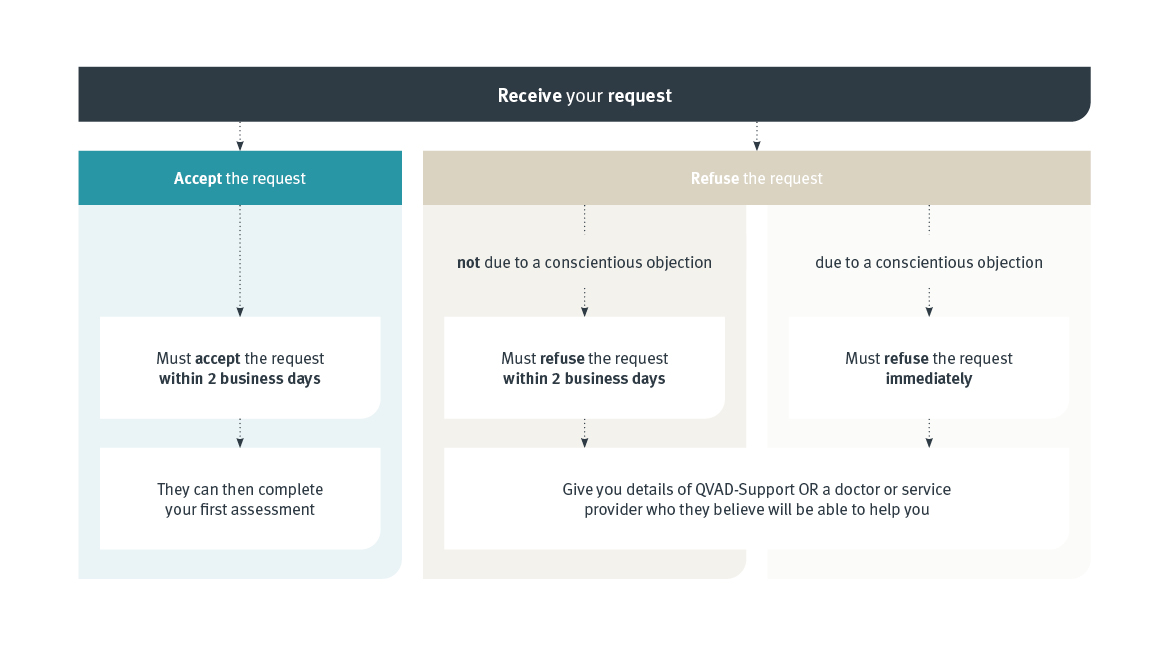
If the reason for refusing the first request is a conscientious objection, the doctor must immediately inform you of this reason. Otherwise, the doctor must inform you of their acceptance or refusal within 2 business days after the first request is made.
If the doctor accepts the first request, they become your coordinating practitioner (coordinating doctor) and must give you the approved voluntary assisted dying first request information. The coordinating doctor supports you through the process. To be a coordinating doctor a doctor must meet eligibility criteria and have completed the mandatory training.
View larger image
Flowchart of the timeframes a doctor follows when responding to a first request for voluntary assisted dying.
First assessment
Following your first request, your coordinating doctor assesses if you are eligible for voluntary assisted dying.
To be eligible for voluntary assisted dying, your coordinating doctor will assess you against each of the eligibility criteria.
If your coordinating doctor wants a second opinion
If your coordinating doctor cannot determine if you:
have a disease, illness or medical condition that is advanced, progressive, and is expected to cause death within 12 months, that is causing intolerable suffering
have decision-making capacity in relation to voluntary assisted dying
are acting voluntarily or without coercion
they must refer you to another registered health practitioner or person with appropriate skills and training to determine if you do.
Once you have been to your referral appointment and your coordinating doctor has received the report, they can choose to:
adopt the determination in the report
rely on their own determination
seek a further determination (there is no limit on the number of times this can occur).
Your coordinating doctor will use their clinical judgement and expertise in making this decision.
Understand specific information provided
If your coordinating doctor believes you meet all the eligibility criteria they will give you information about:
your diagnosis and prognosis
the treatment options available to you and the likely outcomes of that treatment
the palliative care and treatment options available to you and the likely outcomes of that care and treatment
the request and assessment process, including the requirement for a written request (the second request) signed in the presence of 2 witnesses
the potential risks of self-administering or being administered the voluntary assisted dying substance likely to be prescribed
that the expected outcome of self-administering or being administered the voluntary assisted dying substance is death
the method the voluntary assisted dying substance is likely to be self-administered or practitioner administered
the fact that you can decide at any time not to continue the request and assessment process or not to access voluntary assisted dying
if you are receiving ongoing health services from other healthcare workers you might wish to tell them about your request to access voluntary assisted dying.
Before you can be assessed as eligible to access voluntary assisted dying your coordinating doctor must be satisfied that you understand the information you are given.
Outcome of the assessment
Assessed as eligible
You will be assessed as eligible and meeting the requirements of the first assessment If your coordinating doctor is satisfied you:
meet all the eligibility criteria
understand the information provided.
Your coordinating doctor will then refer you to another doctor for a second assessment–called the consulting assessment.
If the other doctor accepts the referral, they become your consulting practitioner (consulting doctor).
Assessed as ineligible
Your coordinating doctor can assess you as ineligible for voluntary assisted dying if they are not satisfied you:
meet all the eligibility criteria
understand the information given to you about voluntary assisted dying.
If your coordinating doctor assesses you as ineligible, the voluntary assisted dying process ends.
If your coordinating doctor decides that you are ineligible, they will:
Explain why you are not eligible.
If relevant, they may explain that your eligibility might change, if your circumstances change in the future. They may also explain that if your eligibility changes in the future, you may start the process again by making a new first request with them or a different doctor. For example, if your prognosis changes, you may become eligible for voluntary assisted dying at a later date.
If the decision is reviewable by the Queensland Civil and Administrative Tribunal (QCAT), give you information about the decisions, the reasons for the decision and your right to have the decision reviewed by QCAT.
Give you a written copy of their decision.
Your coordinating doctor may also talk to you about other care and support available to you. This could include:
discussing how your treating healthcare team may help ease any physical symptoms, psychological, social or spiritual distress you may be experiencing
updating your care plan
providing you with alternate referrals to relevant healthcare workers
organising additional support from a specialist palliative care team (if one is not already involved in your care)
discussing your ineligibility for voluntary assisted dying with other members of your healthcare team and family, if you do not want this to happen though they will respect your privacy.
What you can do
If your coordinating doctor assesses you as ineligible you can:
make a new first request to a different doctor
if your situation changes, make a new first request to the same doctor at a different time.
If you do this the voluntary assisted dying process will start from the beginning.
Your consulting doctor will do a second, independent assessment, to decide if you are eligible.
Your consulting doctor can also refer you for a second opinion to determine if you:
have a disease, illness or medical condition that is advanced, progressive, and is expected to cause death within 12 months, that is causing intolerable suffering
have decision-making capacity in relation to voluntary assisted dying
are acting voluntarily or without coercion.
Outcome of the assessment
Assessed as eligible
You will be assessed as eligible and meeting the requirements of the consulting assessment If your consulting doctor is satisfied you:
They will advise your coordinating doctor that they have assessed you as eligible. You can then make a second request to your coordinating doctor.
Assessed as ineligible
Your consulting doctor can assess you as ineligible for voluntary assisted dying if they are not satisfied you:
meet all the eligibility criteria
understand the information given to you about voluntary assisted dying.
If your consulting doctor assesses you as ineligible, your coordinating doctor may refer you to another doctor for another consulting assessment. There is no limit on the number of times this can happen. However, if your coordinating doctor does not think it is appropriate to refer you, the process ends.
You can also apply to have certain consulting and coordinating doctors’ decisions reviewed by QCAT.
What you can do
If your coordinating doctor decides not to refer you for another consulting assessment you can:
make a new first request to a different doctor
if your situation changes, make a new first request to the same doctor at a different time.
If you do this the voluntary assisted dying process will start from the beginning.
Second request
You can stop the process at any time
You do not have to continue with the voluntary assisted dying process after the first and consulting assessments. You can stop the process at any time.
If you are assessed as eligible and you want to continue, you can make a second request, to your coordinating doctor in writing, to access voluntary assisted dying.
The second request can be made at any time after the consulting assessment is completed, and you have been assessed as eligible.
To make a second request you must complete the Second Request Form in writing. Your coordinating doctor will give you a copy of this form.
To complete the form, you must:
sign the Second Request Form in front of 2 eligible witnesses
physically sign the form, this means you and your 2 witnesses cannot use a digital signature
if you need an interpreter, they can sign the form electronically.
You do not need to complete the Second Request Form in the presence of your coordinating doctor.
If you are unable to write, you can ask someone else to sign the Second Request Form on your behalf. They must sign this front of you and your 2 witnesses. To be able to sign the request on your behalf the person must physically sign the Second Request Form in front of 2 eligible witnesses.
Your witness will need to certify that:
you signed the request in front of them
you appeared to sign the request freely and voluntarily.
Your witnesses must also state in the form that they are not knowingly an ineligible witness.
A witness cannot be:
someone who knows or believes that they are a beneficiary under your will or may benefit from your death
the owner or responsible for the management of any health facility where you are being treated or live
your coordinating or consulting doctor.
If you cannot find anyone to be your witnesses, you can:
speak to your coordinating doctor who may be able help you find witnesses
You do not need to fill in any forms to appoint someone as your witness. However, you should let your coordinating doctor know who is going to act as your witnesses.
If you are unable to write, you can ask someone else to sign the Second Request Form on your behalf. They must sign this front of you and your 2 witnesses. To be able to sign the request on your behalf the person must:
be at least 18 years of age
not be a witness to the signing of the request
not be your coordinating or consulting doctor.
You must give the signed Second Request Form to your coordinating doctor.
Further information
The following resources are available for you and your witnesses when completing the second request:
If you wish to continue with the request process, the next step is to make a third and final request to your coordinating doctor.
Final request and final review
Final request
After the second request is completed, signed, witnessed, and given to your coordinating doctor, you can make a third and final request for access to voluntary assisted dying.
If you decide to make a final request, you must make this request yourself to your coordinating doctor. This request can be made verbally, or by other means of communication such as hand gestures.
You should make the final request when you are ready. However, there is a 9-day minimum timeframe between the first and final request and the earliest you can make your final request is the 10th day after your first request was made and accepted, unless there are exceptional circumstances.
You must also wait until the day after your consulting assessment to make a final request.
What happens next
Your coordinating doctor may start the final review process after you have made a valid final request.
Final review
In this step your coordinating doctor will confirm if the request and assessment process has been completed correctly.
Your coordinating doctor must confirm that:
the request and review process was completed correctly
you still have decision-making capacity
you are acting voluntarily and without coercion.
Outcome of final review
Coordinating doctor is satisfied requirements are met
If your coordinating doctor is satisfied that the requirements of the final review have been met and if you wish to continue with the voluntary assisted dying process, the next step is to make an administration decision.
You can stop the process at anytime
You do not have to continue the voluntary assisted dying process after the request and assessment has been completed. You can stop the process at any time.
Coordinating doctor is not satisfied requirements are met
If your coordinating doctor is not satisfied, they will not move you onto the next stage.
Your coordinating doctor will:
Explain their decision.
If relevant, they may explain that your eligibility might change, if your circumstances change in the future and you may start the process again by making a new first request with them or a different doctor. For example, if your decision-making capacity changes, you may become eligible for voluntary assisted dying at a later date.
If the decision is reviewable by the Queensland Civil and Administrative Tribunal (QCAT), give you information on the decision, the reasons for the decision and your right to have that decision reviewed by QCAT.
Your coordinating doctor will also talk to you about other care and support available to you. This could include:
discussing how your treating healthcare team may help ease any physical symptoms, psychosocial or spiritual distress you may be experiencing
updating your care plan
providing you with alternate referrals to relevant healthcare workers.
What you can do
If your coordinating doctor is not satisfied that you still have decision-making capacity and are acting voluntarily and without coercion, you can:
make a new first request to a different doctor
if your situation changes, make a new first request to the same doctor at a different time.
If you do this the voluntary assisted dying process will start from the beginning.
Request and assessment—Voluntary assisted dying process,
08 Dec 2022,
[https://www.qldgovau.staging-services.qld.gov.au/health/support/voluntary-assisted-dying/explained/process/request-and-assessment]
This document is uncontrolled when printed. Before using the information in this document you should verify the current content on https://www.qldgovau.staging-services.qld.gov.au/health/support/voluntary-assisted-dying/explained/process/request-and-assessment.