Crocodile management plan
On this page
In Queensland, estuarine crocodiles are found throughout the Gulf of Carpentaria, Cape York Peninsula, Torres Strait, and along the east coast down to Rockhampton, which marks the southernmost population. Crocodiles are rarely present south of the Fitzroy River, and those that occur are considered vagrants.
The Queensland Government is committed to managing crocodiles to reduce public safety risks.
Our world-class crocodile management program has three complementary components:
- Queensland Crocodile Management Plan: provides the framework for how estuarine (saltwater) crocodiles are managed according to the level of risk they pose.
- Be Crocwise public safety education program.
- Scientific, evidence-based research and monitoring program.
In addition, we have strong laws in place to deter people from engaging in dangerous or careless behaviours like feeding, disturbing and interfering with crocodiles, with significant fines for those who do the wrong thing and jeopardise public safety.
Queensland Crocodile Management Plan
The revised Queensland Crocodile Management Plan (QCMP) 11.7 MB) provides the framework for managing estuarine (saltwater) crocodiles.
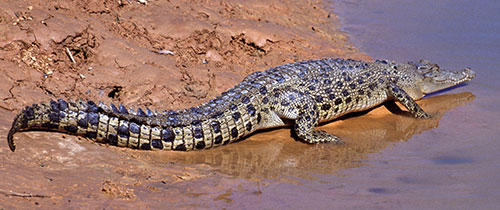
Estuarine crocodiles are a protected species under both a state and national level. They are an important part of Queensland’s ecosystems but can pose significant dangers to humans. Because they present a much higher risk than freshwater crocodiles (Crocodylus johnstoni), the QCMP focuses exclusively on managing public safety risks associated with estuarine crocodiles.
The QCMP strikes the appropriate balance between managing the public safety risks that estuarine crocodiles may pose to humans and the conservation of the species.
It outlines how we will:
- identify risks posed by estuarine crocodiles in different parts of Queensland
- increase public safety through an evidence-based approach
- provide a consistent approach to estuarine crocodile management across the species’ range that supports estuarine crocodile conservation, including how we will consistently respond to sightings.
It has been informed by recommendations from an independent expert committee, evidence-based science and stakeholder and community feedback.
The QCMP uses an overarching 'response-based management approach', which involves taking appropriate action based on the crocodile management zone where the animal has been identified.
Importantly, any estuarine crocodile that poses a threat to human safety will continue to be targeted for removal.
Key changes
The revised QCMP includes 3 key changes from the previous 2017 version.
- Zones numbers and names: consolidates the number of crocodile management zones from 6 to 4 zones and amended the zone names.
- Zone areas and maps: updates to some existing zone areas by zone type and/or boundary (refer to crocodile management zone maps below).
- Annual feedback process: each year, a four-week public consultation period will provide an opportunity for residents, stakeholders, and local organisations to request changes or seek a review of crocodile management zones. As new verified risks are identified, changes to the location and/or boundaries of the crocodile management zones will be considered as required, ensuring changes are not limited to the mandatory five-year review cycle. In addition to annual consultation period, the QCMP will be reviewed every five years to ensure it remains fit for purpose and reflects the latest science, monitoring data, and community expectations.
In addition, the QCMP also clearly outlines the management responses for each zone; how ‘problem crocodiles’ are identified, targeted for removal and what happens to those that have been removed; details of new scientific research and in-situ management trials.
Additional updates following community consultation
Following consultation on the draft QCMP in 2024, further refinements were made to several crocodile management zones to reflect community feedback and enhance public safety. These include:
- Cairns Regional Council area – Three new Targeted crocodile removal zones added in the Mulgrave River, including Greenpatch, Peets Bridge, and the Little Mulgrave River.
- Cassowary Coast Regional Council area – Re-zoning of Warrina Lakes Community Parklands to become a Targeted crocodile removal zone.
- Hinchinbrook Shire Council area – Re-zoning of the two front ponds of the Tyto Wetlands to become an Active removal zone.
- Mareeba Shire Council area – Re-zoning of Southedge Dam (Lake Mitchell) to become a Reportable removal zone.
Crocodile management zones
The QCMP has 4 different zones. These zones determine specific management activities and responses (including removals in certain circumstances) based on the level of risk.
Active removal zone (AR zone)
- Applies to areas where the risk of human–crocodile interaction is high due to the significant number of people living in the area.
- In this zone, all estuarine crocodiles—regardless of size or behaviour—are targeted for removal.
Targeted crocodile removal zone (TCR zone)
- Applies to areas near urban centres and popular leisure sites where the risk of human–crocodile interaction is high.
- In this zone, all estuarine crocodiles that are two metres or greater in length, and any crocodile displaying dangerous behaviour (following a problem crocodile determination), are targeted for removal.
General management zone (GM zone)
- Applies to all areas of Queensland’s of typical crocodile habitat not designated as an Active removal zone or Targeted crocodile removal zone.
- In this zone, all estuarine crocodiles displaying dangerous behaviour (following a problem crocodile determination) are targeted for removal.
Reportable removal zone (RR zone)
- Applies to the areas of Queensland that are not typical habitat for crocodiles.
- In this zone, all estuarine crocodiles are targeted for removal once their presence has been confirmed.
Crocodile management zone maps
The crocodile management zones are shown on the following crocodile management zone maps:
- Queensland crocodile management zones overview map 4.9 MB)
- Cairns Regional Council crocodile management zone map 6.7 MB)
- Changes from the previous version include:
- an extension of the Smiths Creek Active removal zone to include all of Chinaman Creek in Trinity Inlet at Portsmith and along the western side of Admiralty Island. This extension was made following the consultation process to join the gap between two existing sections of AR zone which contains key recreation areas including 2 high use boat ramps at Smith Street and Tingira Street. In this zone, all estuarine crocodiles found in this zone are targeted for removal.
- the addition of three new areas to the Targeted crocodile removal zones in the Mulgrave River. These additions were made to include high-use recreation areas at Greenpatch, Peets Bridge and the Little Mulgrave River. In this zone, all estuarine crocodiles that are two metres or greater in length, and any crocodile displaying dangerous behaviour (following a problem crocodile determination), are targeted for removal.
- Changes from the previous version include:
- Cassowary Coast Regional Council crocodile management zone map 1 of 2 13.3 MB)
- Cassowary Coast Regional Council crocodile management zone map 2 of 2 5.1 MB)
- Changes from the previous version include re-zoning of Warrina Lakes Botanical Garden to become a Targeted crocodile removal zone. This change was made following the consultation process to enhance public safety in a space frequently used by the community while also maintaining acceptable conservation outcomes.
- In this zone, all estuarine crocodiles that are two metres or greater in length, and any crocodile displaying dangerous behaviour (following a problem crocodile determination), are targeted for removal.
- Douglas Shire Council crocodile management zone map 993.2 KB)
- Gladstone Regional Council crocodile management zone map 901.8 KB)
- Hinchinbrook Shire Council crocodile management zone map 4.3 MB)
- Changes from the previous version include re-zoning part of the two front ponds in the Tyto Wetlands to become an Active crocodile removal zone. This change was made following the consultation to address safety concerns arising from the proximity of the front ponds to a children’s playground and visitor information centre.
- In this zone, all estuarine crocodiles, regardless of size or behaviour, are targeted for removal.
- Mackay Regional Council crocodile management zone map 969.7 KB)
- Mareeba Shire Council crocodile management zone map 3.6 MB)
- Changes from the previous version include re-zoning of Southedge Dam (Lake Mitchell) and a section of the Barron River to become a Reportable removal zone. These changes were made at the request of Mareeba Shire Council to reflect the fact that saltwater crocodiles do not usually inhabit those areas.
- In this zone, all estuarine crocodiles found in this zone are targeted for removal.
- Rockhampton Regional and Livingstone Shire Council crocodile management zone map 1 MB)
- Changes from the previous version of the QCMP include re-zoning of lagoons adjoining the botanic gardens to become a Targeted crocodile removal zone. This change was made following the consultation process and to enhance public safety in a space frequently used by the community while maintaining acceptable conservation outcomes.
- In this zone, all estuarine crocodiles greater than 2m and smaller crocodiles displaying dangerous behaviour (following a problem crocodile determination) in this zone are targeted for removal.
- Townsville City Council crocodile management zone map 2.5 MB)
Annual feedback process
Each year, a four-week public consultation period will provide an opportunity for residents, stakeholders, and local organisations to request changes or seek a review of crocodile management zones. As new verified risks are identified, changes to the location and/or boundaries of the crocodile management zones will be considered as required, ensuring changes are not limited to the mandatory five-year review cycle. In addition to annual consultation period, the QCMP will be reviewed every five years to ensure it remains fit for purpose and reflects the latest science, monitoring data, and community expectations.
The first annual review process will be held in late 2026.
Consultation
Consultation on the revised draft of the Queensland Crocodile Management Plan 3.6 MB) was undertaken in 2024. Feedback was sought via an online survey and written submissions. Further refinements were made following the consultation to reflect community feedback and enhance public safety, which are detailed in the final plan 11.7 MB).
Related information
- Crocodile sightings and attacks
- Learn more about how to Be Crocwise.