Terrestrial vertebrate fauna survey guidelines
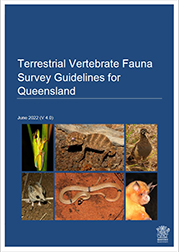
The Terrestrial Vertebrate Fauna Survey Guidelines 4.6 MB) for Queensland outline the minimum survey requirements, survey standards and appropriate practice for the survey of terrestrial vertebrate fauna in Queensland. The document provides details of appropriate standard methods and associated equipment for the systematic survey of terrestrial vertebrate fauna, as well as recommendations on animal handling, improving survey adequacy, storing and managing survey data, and undertaking habitat assessment.
Field data sheets
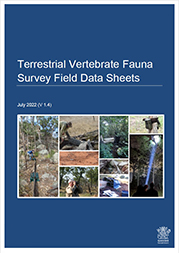
View the field data sheets 625.5 KB) that are associated with the survey methods outlined in the Terrestrial Vertebrate Fauna Survey Guidelines for Queensland.
- Datasheet description and purpose
- Site information
- Diurnal bird surveys
- Herpetofauna searches
- Elliott, pitfall, funnel, cage and turtle trapping
- Arboreal spotlight and nocturnal call playback
- Incidental records on survey sites
- Incidental fauna sightings
- Bat trapping
- Camera trapping
- Acoustic recording
- Hair tubes
- Scat and sign searches
- Vehicle and foot road transects
- Amphibian search
- Waterbird/shore bird survey
Targeted species survey guidelines
Guidelines for the targeted survey of Queensland’s threatened species, as listed under the Nature Conservation Act 1992, are also being developed and will be posted as they are completed. These targeted guidelines provide details of appropriate survey approaches and effort to maximise the likelihood of detecting threatened species, as well as information on identification, current known distribution, habitat preferences, and ethical and handling considerations.
The Queensland Government threatened species survey guidelines complement the existing survey guidelines for species listed nationally under the Environmental Protection and Biodiversity Conservation (EPBC) Act 1999, as provided by the Commonwealth Department of Agriculture, Water and the Environment.
Download the targeted species survey guidelines
Targeted species survey guidelines are available for selected threatened species. Other targeted species guidelines will be added and existing ones updated on a regular basis.
Frogs
- Adelotus brevis, tusked frog 161.7 KB)
- Crinia tinnula, wallum froglet 104.7 KB)
- Litoria cooloolensis, Cooloola sedgefrog 109 KB)
- Litoria freycineti, wallum rocketfrog 95.5 KB)
- Litoria olongburensis, wallum sedgefrog 120.2 KB)
- Litoria pearsoniana, cascade treefrog 108.9 KB)
Reptiles
- Ctenotus capricorni, Capricorn ctenotus 149.8 KB)
- Ctenotus schevilli, black-soil rises ctenotus 191.7 KB)
- Ctenotus serotinus, gravel-downs ctenotus 247.3 KB)
- Egernia rugosa, yakka skink 657.7 KB)
- Acanthophis antarcticus, common death adder 136.1 KB)
- Hemiaspis damelii, grey snake 111.2 KB)
Birds
- Probosciger aterrimus, palm cockatoo 195.8 KB)
- Calyptorhynchus lathami, glossy black-cockatoo 155.1 KB)
- Grantiella picta, painted honeyeater 151.2 KB)
Mammals
- Vombatus ursinus, bare-nosed wombat 238.2 KB)
- Sminthopsis douglasi, Julia Creek dunnart 1.3 MB)
- Petrogale purpureicollis, purple-necked rock-wallaby 129.4 KB)
- Petrogale sharmani, Sharman’s rock-wallaby 189.8 KB)
- Hipposideros cervinus, fawn leaf-nosed bat 143.4 KB)
- Hipposideros diadema reginae, diadem leaf-nosed bat 148.3 KB)
- Hipposideros stenotis, northern leaf-nosed bat 129.2 KB)
- Macroderma gigas, ghost bat 213.4 KB)
- Murina florium, flute-nosed bat 137.5 KB)
- Rhinonicteris aurantia, orange leaf-nosed bat 154.4 KB)
- Taphozous australis, coastal sheathtail bat 138.7 KB)