Skip to main content Skip to main navigation
qld.gov.au Delivering for Queensland - Queensland Government
Find services Business Queensland Government employees Contact us
Delivering for Queensland - Queensland Government
Popular
  • Public holidays
  • Driver licence
  • Car rego
  • Apply for a Blue Card
  • Find a JP
Menu
  • Home
  • Menu
    • Aboriginal and Torres Strait Islander peoples
    • Community support
    • Education
    • Emergency services and safety
    • Environment, land and water
    • Family, relationships, births and deaths
    • Health
    • Housing
    • Jobs and work
    • People with disability
    • Queensland's government
    • Recreation, sport and arts
    • Seniors
    • Transport
    • Your rights, crime and the law
    • Youth
  • Find services
  • Business Queensland
  • Government employees
  • Contact us
  1. Home
  2. Transport
  3. Road safety, rules, fines and tolls
  4. Road rules
  5. Child restraints
  6. When to move to the next type of restraint

Road rules

  • Road rules for everyday driving
  • Sharing the road with other road users
  • Child restraints
    • Types of child restraints
    • When to move to the next type of restraint
    • Installing a child restraint
    • Where children should sit
    • Exemptions from complying with standard child restraint laws
  • Speed limits
  • School zone parking and pick-up
  • Bicycles, skateboards, foot scooters and similar
  • Motorcycle road rules
  • Rules for hire 4WD vehicles on K’gari (formerly Fraser Island)
  • Vehicles and devices you cannot use on the road

Child restraints

When to move to the next type of restraint

  • Types of child restraints
  • Installing a child restraint
  • Where children should sit
  • Exemptions from complying with standard child restraint laws

Since 2011, all approved child restraints will have markings on the seat that show the upper and lower seated shoulder height of the child.

You can move your child to the next type of restraint when their seated shoulder height is above the top mark on the restraint.
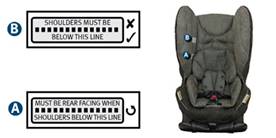
Australian Standards approved forward-facing child restraint showing the shoulder height markings

In this guide

  1. Types of child restraints
  2. When to move to the next type of restraint
  3. Installing a child restraint
  4. Where children should sit
  5. Exemptions from complying with standard child restraint laws

Print entire guide

Previous Next

Child restraint video guides

Watch our series of videos showing how to install and use a child restraint on the StreetSmarts website.

Last updated:
10 May 2023

Your browser is not supported. Some functionality might not work as expected.

Please upgrade your browser to a version on the supported browser list

Queensland Government

Contact us

Get in touch for enquiries, feedback, complaints and compliments.

Contact us
Phone: 13 QGOV (13 74 68)
/QueenslandGovernment
@QldGov
  • Help
  • Copyright
  • Disclaimer
  • Privacy
  • Right to information
  • Accessibility
  • Jobs in Queensland Government
  • Other languages

Website feedback

Help us improve the content on our website or tell us what is working well.

Leave your feedback
Loading...
Close

Cultural acknowledgement

We pay our respects to the Aboriginal and Torres Strait Islander ancestors of this land, their spirits and their legacy. The foundations laid by these ancestors—our First Nations peoples—give strength, inspiration and courage to current and future generations towards creating a better Queensland.

© The State of Queensland 1995 - 2026